Almost uniquely with women
7 June 1831

Well, it’s Pride month, so let’s celebrate the 195th anniversary of the birth of Amelia Edwards, ghost story writer, poet, novelist, pioneering traveller, Egyptologist, campaigner for the preservation of ancient stuff, and someone who
formed emotional attachments almost uniquely with women.
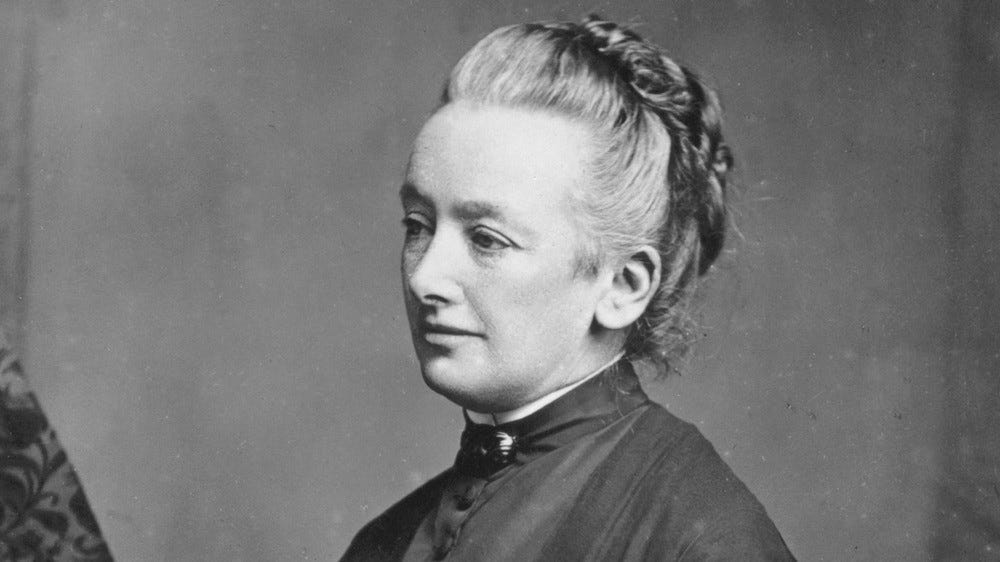
She was apparently described as the “precocious of the precocious” in her youth, publishing her first poem as a 7-year-old, and getting noticed as an artist by George Cruikshank when she was 12. He would have taken her on as a pupil, but for her parents’ “prejudice against the artist life”.
At 20, she got engaged to a man, apparently to stop her parents worrying about what she’d live on when they were gone, but the Oxford Dictionary of National Biography says she “dreaded the walk home from church with her fiancé” and broke it off within a year. When she was 25, she said she studied “perspective, fencing, oil painting, pistol-shooting, riding, smoking, mathematics”, and when she published her book Untrodden Peaks and Unfrequented Valleys about her journey in the Dolomites, she illustrated it herself.
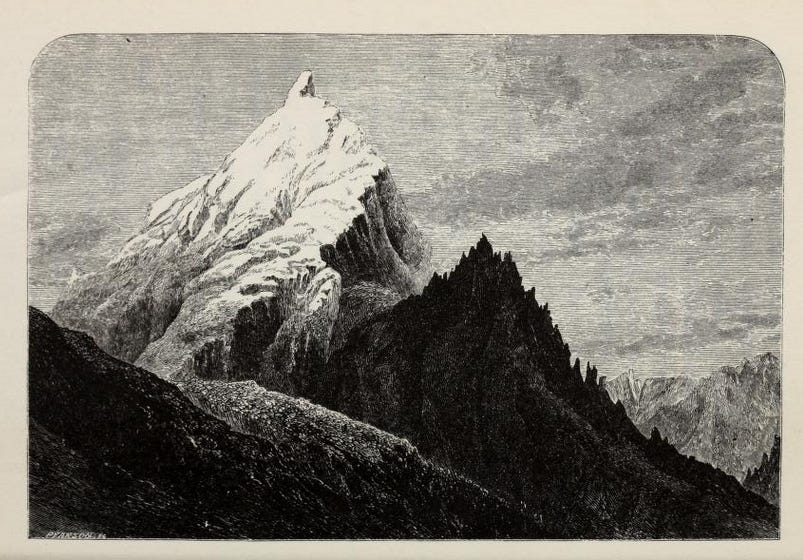
She went to the Italian mountains with a... ‘friend’, Lucy Renshaw – described by historian Bianca Walther as “an unmarried, freedom-loving woman of independent means” – and became the first hiker to get to the top of one of the peaks, Sasso Bianco.
They had a ‘courier’ at first, but parted company with him and hired their own guides, because he wasn’t as prepared to rough it as they were:
living for many weeks to come in Tyrolean albergos several degrees less comfortable than the Aquila Nera, was too much for the great man’s philosophy. He understood, he said, that there were no carriage-roads to most of the places laid down in our maps, and “no suitable accommodation such as he was accustomed to when travelling with parties who placed confidence in his opinion;” he therefore begged leave to tender his resignation, and his accounts.
In the book, though, she does acknowledge that they may not be typical women of their era. English Professor Patricia O’Neill says:
Edwards cautions her readers of the necessity of side-saddles, for ‘the passes are too long and too fatiguing for ladies on foot’.
When they come down from the mountains, she writes, with an audible air of frustration: “here is the railway; here is the hot, dusty, dead-level World of Commonplace again!” So they didn’t remain in England long, and set off for France, but terrible weather made them head to Egypt instead. This led to her most popular book (although she also wrote eight novels, cartoons, and three etiquette books), which was reprinted as recently as 2022 (almost all her others are long since out of print) – and it’s at least as much a work of scholarship as a travelogue.
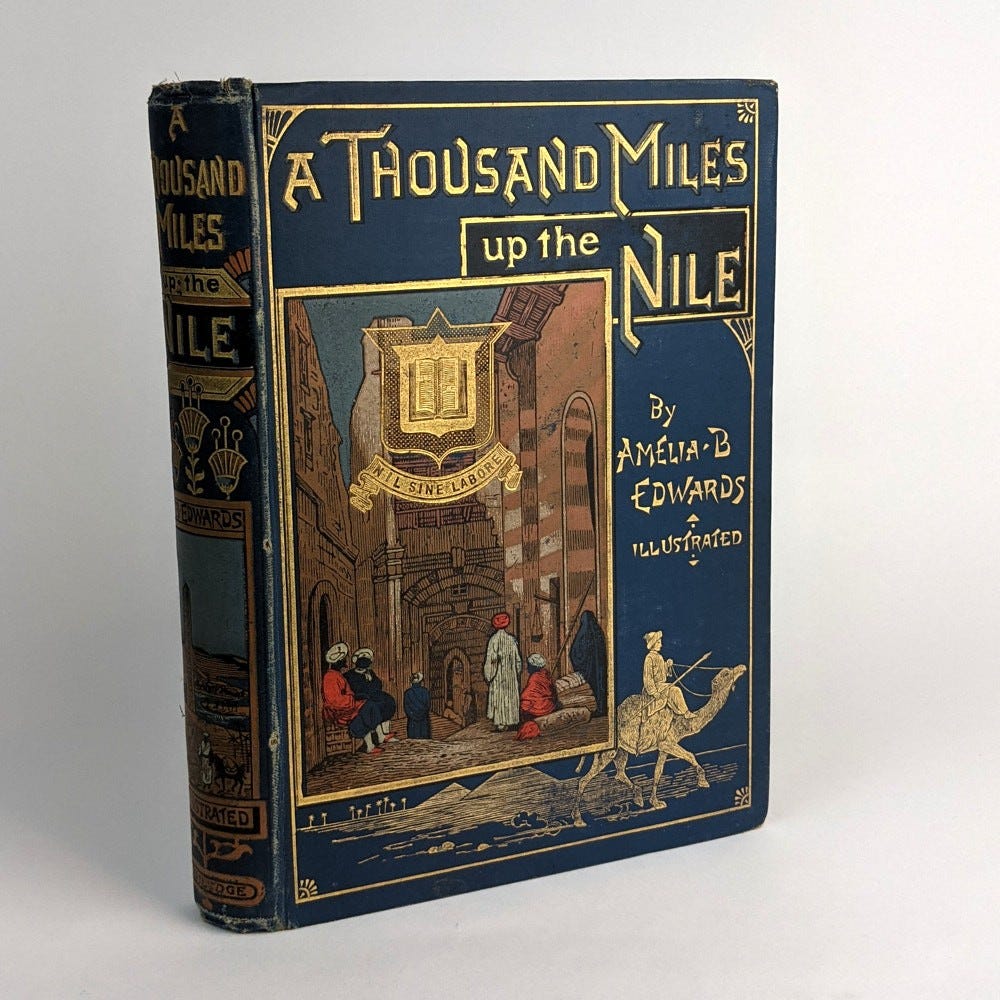
Amelia got so interested Egyptology that she co-founded the Egypt Exploration Fund (now the Egypt Exploration Society) and left money to it in her will – and to University College London, which still has an Edwards Professor of Egyptian Archaeology and Philology named after her. She wrote the entry for ‘mummy’ in the 1902 Encyclopædia Britannica and did a lecture tour of the US to raise money to protect ancient monuments from tourists, grave robbers, and development. She published the lectures under the title Pharaohs, Fellahs and Explorers.
Obviously, a female travelling companion and a broken engagement aren’t definitive proof that she wasn’t straight, but she did live for about three decades with Ellen Drew Braysher, a widowed ‘friend’ who was 27 years older than her – and corresponded with painter Marianne North. Bianca Walther says:
Edwards’ letters have not survived, [but] North’s replies reveal that Edwards had developed quite a crush on her new friend ... ‘Bless you, what love letters you do write’, she wrote one Friday in May 1871, ‘what a pity you waste them on a woman!’
After her travels with Renshaw,
Edwards’ closest confidante from the second half of the 1880s until her death was Kate Bradbury, 22 years her junior, who would accompany her on the last two trips she took: to the United States (1889/90) and Italy (1891).
Again, none of this is proof, although she did also make friends with “poet Eliza Cook, actress Charlotte Cushman, and translator Matilda Hays”. Cook had “had a short fling” with Cushman, but when Edwards knew them, Cushman was in a relationship with Hays. Edwards
visited Cushman and Hays in Rome, where the couple regularly spent the winters in a household of “jolly female bachelors” ... including American sculptor Harriet Hosmer (who later became involved with Scottish philanthropist Louisa Baring)
Again, not proof. Necessarily. Although, as Oscar Wilde didn’t quite say, having one or two lesbian friends might be an accident, but having that many begins to look like you don’t consider it a misfortune – and then there’s the question of writer John Addington Symonds. He lived near Amelia, and they apparently exchanged letters which were “distinctly intimate & personal in nature” – and not in the sense that they were saucy, rather that they were entirely candid. After Amelia’s death, Symonds wrote to sexologist Havelock Ellis:
I had another eminent female author among my friends, Miss Amelia B. Edwards, who made no secret to me of her Lesbian tendencies. The grande passion of her life was for an English lady, married to a clergyman & inspector of schools. I knew them both quite well. The three made a menage together; & Miss Edwards told me that one day the husband married her to his wife at the altar of his church – having full knowledge of the state of affairs.
This referred to John Rice Byrne and Ellen Byrne, and we don’t know exactly what happened – this is, after all, Symonds’ recollection of what Amelia told him, not something she wrote down herself – but:
If Edwards and Ellen Byrne had indeed sought some sort of blessing for their union, they would not have been the first to do so: In 1832, Yorkshire landowner Anne Lister took the sacrament together with her partner Ann Walker during a church service and considered it a sealing of their relationship. It does seem unusual that the ceremony would be performed by a pastor who was (a) aware of what the act meant for the women in question and (b) the husband of one of them, yet it is not implausible that some sort of ceremony would have been important to two Protestant Victorian women.
Sadly, Rev. Byrne was also a schools inspector, and was moved to a different district, so it didn’t last. But Havelock Ellis wrote in Studies in the Psychology of Sex:
I know of one case, probably unique, in which the ceremony was gone through without any deception on any side: a congenitally inverted Englishwoman of distinguished intellectual ability, now dead, was attached to the wife of a clergyman, who, in full cognizance of all the facts of the case, privately married the two ladies in his own church.
So while we don’t know Edwards was a lesbian... well, it looks pretty bloody likely, doesn’t it? Especially if you read the handwritten note in the front of a copy of one of her books which she gave Lucy Renshaw, which ends:
I love thee, & am loved – & lo! The sun’s up in God’s heav’n at last!
...oh, and there’s also a poem, again written by hand, in the same volume:
On the Rose she gave me
I hold in my hand the rose you wore
Last night in your bosom – its perfume shed,
The faint, sweet blush of its beauty fled
Like the bloom from the lips of a maiden dead; –
– a rose no more!Rock’d on thy heart as it rose & fell,
For thy sake forgetting the sun & the dew,
Breathing thy breath the long ev’ning through,
What it felt, what it saw, what it dream’d, what it knew,
Who shall tell?Turn’d it pale, do you think, for the wild, brief bliss
Of loving those treasures near which it lay
(Twin blossoms that know not the light of day)
Which I would barter my soul away
But to kiss?Oh, that the fate of the rose were mine!
Just for one night in thy bosom to lie –
For just that one night in thy bosom, to die,
Yielding life, love, song, in one long sigh
Were divine!
Yeah, call me wildly impulsive if you will, but I’m going to go out on a limb and say my money’s on this being appropriate for Pride Month.