Contemporary resonance? Here...?
13 April 1821

It’s the 205th anniversary of Gregor MacGregor’s PROCLAMATION To the Inhabitants of the Territory of Poyais, or Poyers, as he called them, that he was now Cazique of Poyais, because the King of the Mosquito Shore said so. Gregor had, you see, been given eight million acres of what is now the shore of Honduras by
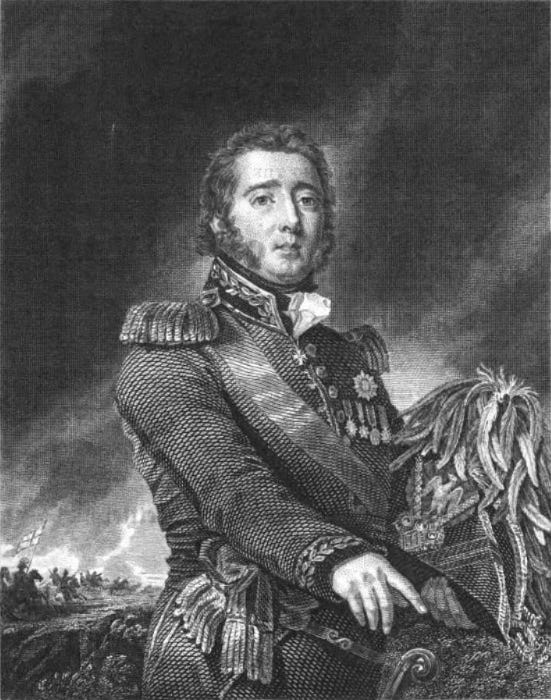
There is, you may not be surprised to hear, not a shred of evidence to suggest that ‘king’ G.F.A. did any such thing – but he did exist, and had made some kind of agreement with Gregor “in exchange for rum and trinkets”. Gregor, however, assured the good people of London and Edinburgh that it had happened on 13 April 1821, and that Poyais was quite the up and coming investment opportunity.
At No. 1 Dowgate Hill, London, he established the Poyaisian Legation, where he displayed a parchment map showing the territory of Poyais, neatly marked out into squares of 540 acres each. He advertised the sale of lands at one shilling an acre cash, and one cent an acre annual quit rent. He issued banknotes promising to pay “on demand, or three months after sight, in the option of the Government of Poyais, One Hard Dollar”. He then took steps to float a loan of 200,000 pounds sterling for the service of the “State of Poyais”. Neatly engraved bonds were issued entitling the purchaser to four per cent interest, payable semi-annually. These bonds bore the signature of “Gregor the First, Sovereign Prince of the Independent State of Poyais and its Dependencies, Cazique of the Poyer Nation, etc., etc., etc.”’
...or, to put it another way, started making a shitload of cash selling land he didn’t own. He was quite a plausible person to invest in: a self-confident, swashbuckling type with an impressive military record – as long as you didn’t look too closely. He had fought for Venezuelan independence from Spain alongside Simón Bolívar (and married Bolívar’s niece) and with the 57th (West Middlesex) Regiment of Foot – known as ‘The Diehards’ after their ferocity at the 1811 Battle of Albuera – but Gregor had left said regiment a year or so before that particular battle. To him, of course, this was mere detail. What was important was how marvellous a place Poyais was. He released a book, Sketch of the Mosquito Shore, Including the Territory of Poyais, which
descanted on the valuable commerce and exports, consisting of indigo, cochineal, precious metals, mahogany, dyewoods, logwood, fustic, medicinal gums, hides, tortoise shell, lumber, and provisions.
There were more than 350 pages of praise for this other Eden, this demi-paradise. It had fertile soil, capable of supporting three crops of maize a year. It had beautiful architecture. It had welcoming natives and a three-chambered parliament...
The Quarterly Review of February 1823 tried to persuade people that this sales pitch was balls, mocking this place
where all manner of grain grows without sowing, and the most delicious fruits without planting; where cows and horses support themselves, and where, like another blessed country on the same continent, roasted pigs run about with forks in their backs, crying, ‘come, eat me!’
To no avail. Ballads had been sung in the streets to promote a promised land where the rivers were not just pure, they had nuggets of gold in them. Prospective settlers had been given titles of nobility and army commissions. So, at least two shiploads of people departed in late 1822 and early 1823, and, on arrival, found what the Quarterly Review described as “a paltry town of huts and ‘log-houses’”, and what the Oxford Dictionary of National Biography now calls “only jungles, swamps, and disease”.
A 1927 telling of the story suggests that “Most of the emigrants were Highlanders who had been driven from their homes by the encroachments of the sheep farmers”. Gregor took them for £50,000 (something in the region of £4m today). He had even kindly exchanged their savings for Poyaisian currency before they left. (Yes, that’s right: he had sold them bits of paper printed to look like they came from The Bank of Poyais, which didn’t exist. Still, one thing we can say for this ‘currency’ is that it was worth the paper it was printed on.)
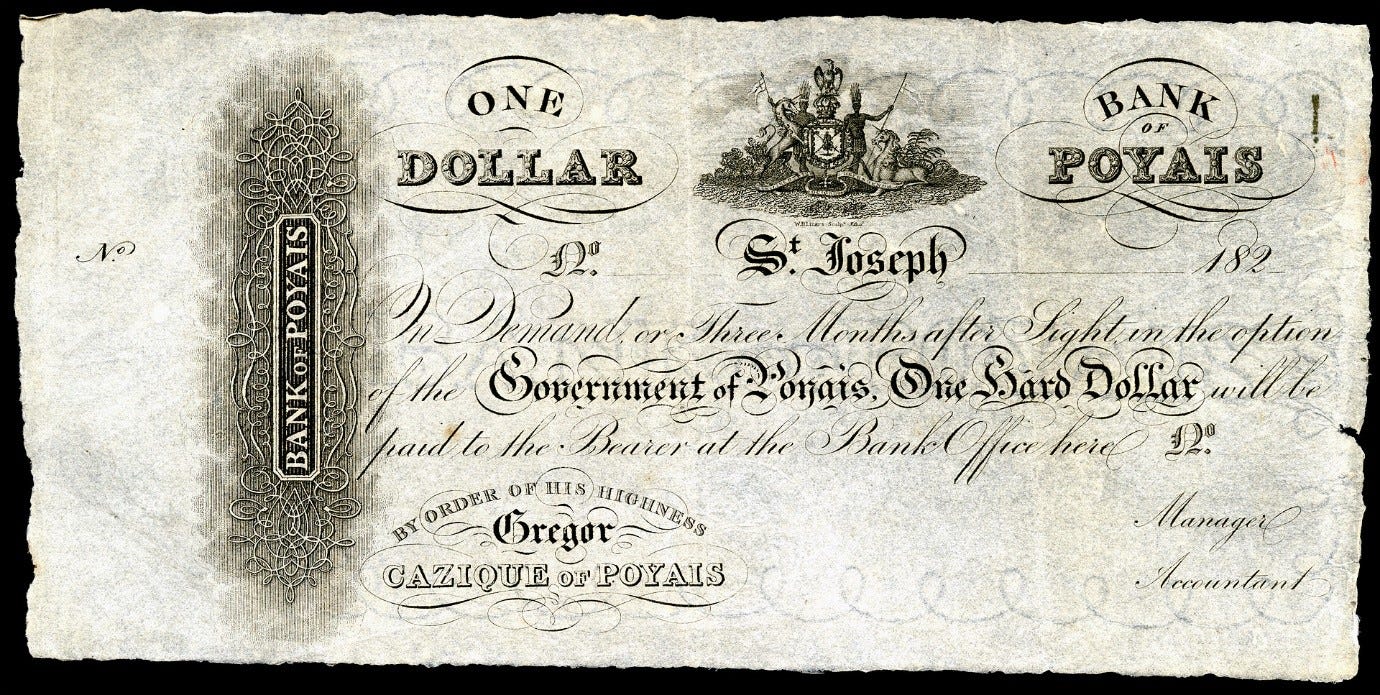
The people he’d conned tried to make the best of it for a few months, although there was some infighting, and, according to one account...
Under such conditions, and unused to a tropical climate as they were, it is no wonder that disease seized upon them and spread rapidly. Lack of proper food and water, and failure to take the requisite sanitary precautions, brought on intermit- tent fever and dysentery. Nine persons died during the first few days and one hundred and twenty fell sick. Whole families were ill. Most of the sufferers lay on the ground without other protection from the sun and rain than a few leaves and branches thrown across some sticks. Many were so weak as to be unable to crawl to the woods for the common offices of nature. The stentch arising from the filth they were in, was unendurable.
Then the King of the Mosquito Nation got in touch. General McGregor
had assumed the title of Cacique in violation of specific prohibitions and since he had failed to fulfil his engagement with his Majesty, the grant of land made to him was now declared null and void.
They could pay for the land again with money they now didn’t have, or they could leave. In one account, a passing ship came to the rescue, and it was either that or…
Early in April, five persons, although in a weak and wretched condition, managed to make their way in an open boat from Saint Joseph’s [the supposedly thriving capital of Poyais] to the British colony at Belize.
Unfortunately, conditions in Belize managed somehow to be worse. As David Sinclair tells it, in The Land That Never Was: Sir Gregor MacGregor and the Most Audacious Fraud in History:
Fevers and other diseases spread rapidly among people already seriously weakened by their ordeal … Of the original 250 or so settlers, fewer than fifty ever saw Britain again.
When word of this reached Britain, MacGregor did what such people tend to: blamed everybody else, sued people for libel, was arrested thanks to the efforts of “some dupes of his previous financial operations”, bought his freedom again for £6,200, and ran off to Paris. Where he saw the error of his ways and stuck to the straight and narrow? No, where he ran the exact same scam again and got himself nicked. Incredibly, though, after several months in prison, he was tried and acquitted. So, obviously, he finally gave up? No, he
returned to London and for the next twelve years travelled between London, Paris, and Edinburgh selling Poyais land grants
Admittedly, this was with ever-decreasing success, but by this stage you may be asking ‘how do fuckers like this keep getting away with it?’ Well, a write-up of Gregor’s story in The Economist a few years ago covered this very question:
New research by Tamar Frankel of Boston University suggests some answers. Ms Frankel studied hundreds of financial cons, looking for recurring patterns. One set that pops up time and time again describes the traits of the victims. They tend to be excessively trusting, have a high risk tolerance, and—especially the more educated victims—have a need to feel exclusive, or part of a special group. Other research shows that victims tend to harbour dissatisfaction with their current economic status, and a desire not to be left behind. Some feel envious of their economic neighbours, which can lead to greedy, risky investing.
Staggeringly, David Sinclair’s The Land That Never Was says that when the survivors got back to their homeland, several of them set about defending Gregor from the attacks on him in the press, saying, among other things:
that part of the report which states that Sir Gregor MacGregor took money from us, it is false and unfounded; on the contrary, we ourselves received money, with many others, from Sir Gregor MacGregor. We had our passage free, as well as that for our wives and families.
Maybe this is the sunk cost fallacy, applied to humans: we want to believe in people, long after they’ve shown us who they really are.
Anyway, in the late 1830s, after his wife died, Gregor went back to Venezuela, and asked to be made a general because of his previous service. This was granted, along with a pension and a lump sum, and he “died peacefully in bed on 4 December 1845” and “was buried in the cathedral with full military honours, with the president of the republic, cabinet ministers, and the diplomatic corps in attendance”
Yes, basically: he just kept getting away with it.
On a happier note, it’s also the 182nd anniversary of Edgar Allan Poe’s ‘Balloon-Hoax’, when he published a ‘report’ in New York’s The Sun about a gas balloon trip across the Atlantic which had taken three days – which he had entirely invented.