Helen Duncan: wartime witch
31 March 1944

It’s 82 years since the guilty verdict was given on the last person to be imprisoned for witchcraft in Britain. No, not 382; 82. Helen Duncan was a Scottish medium who toured the country producing ectoplasm and telling people she could speak to their dead relatives. You know: the usual bollocks.
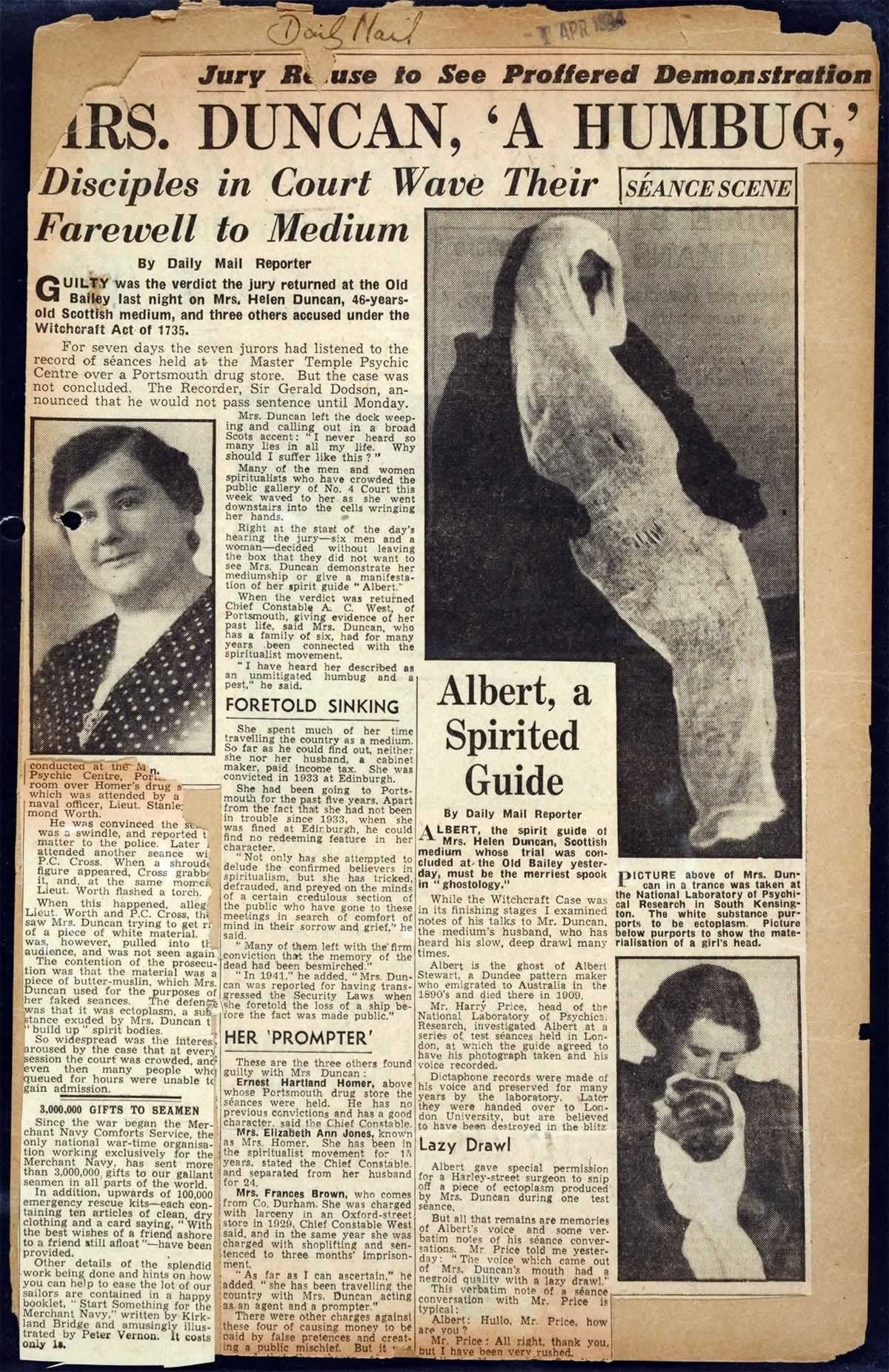
To be fair to her, she’d had a hard life: difficult childhood, and been banished from home for having an illegitimate child. She’d married an invalided soldier, and the hard, manual work she could get didn’t really compare to the job satisfaction of spiritualism. Plus there was the money, of course.
In the late 1920s, she moved on from simple clairvoyance to ‘materialisation’, in which she manifested dead people out of ectoplasm – which turned out to be, variously, cheesecloth, paper soaked in egg whites, toilet paper, artificial silk, and surgical gauze, which she swallowed and regurgitated.
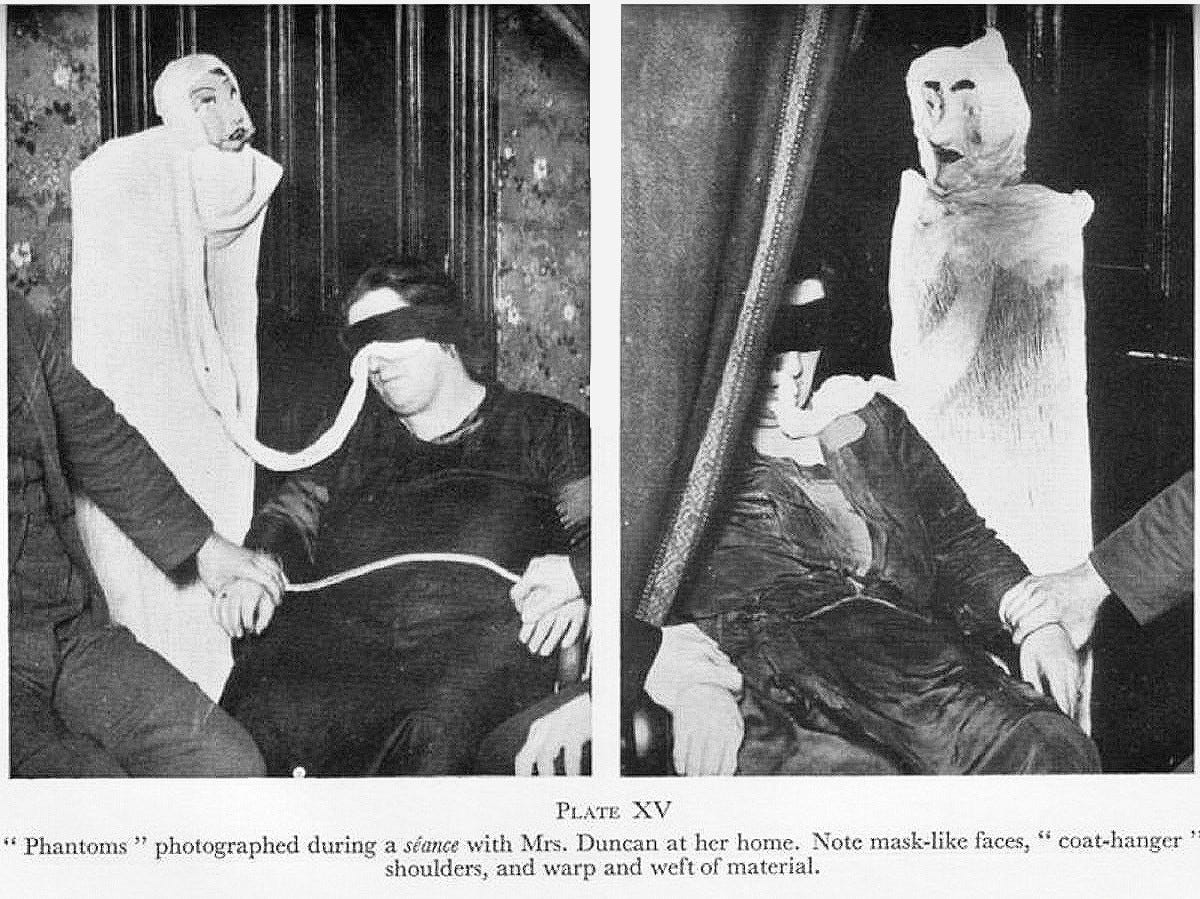
So far, so averagely dishonest – and, of course, as Malcolm Gaskill notes in his entry for her in the Oxford Dictionary of National Biography, when the London Spiritualist Alliance found her to be a fraud, “her reputation soared among many spiritualists”.
In Edinburgh, in 1933, she
was tried at the sheriff court for fraudulently procuring money from members of the public, and was fined £10. Demand for her services increased, the Spiritualists’ National Union renewed her diploma, and she was given a column in a Saturday newspaper.
Things started to unravel during WWII, however. In November 1941, she told a séance in Portsmouth that a dead sailor had just told her HMS Barham had been sunk, and this wasn’t announced to the public until January 1942. So, she was psychic? Er, no.
The relatives of the 891 dead had been told, and been asked to keep it secret, but (a) there were several thousand of them, and (b) good luck stopping that many people telling just one other person each. Whatever had happened, the Navy wasn’t happy and started watching her.
At a séance in January 1944, she told a young lieutenant that his dead aunt had manifested herself, but his aunt was alive. You’d think she’d have tried another mark at this point, but later in the evening suggested his dead sister was there, and she was alive, too. She was arrested at another event a few days later.
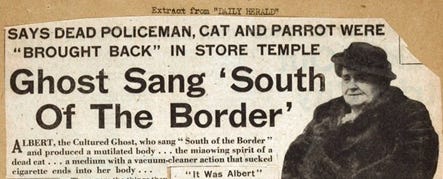
Writing in History Today, Malcom Gaskill says mediums were usually fined under the Vagrancy Act of 1824, “but at this most sensitive point in the war the authorities wanted her in prison – according to her supporters, in case she prejudiced plans for the invasion of Europe”. What seems more likely is that the authorities were annoyed that she was making a lot of money offering people false comfort when others were tightening their belts. That’s certainly what some of the headlines suggest.
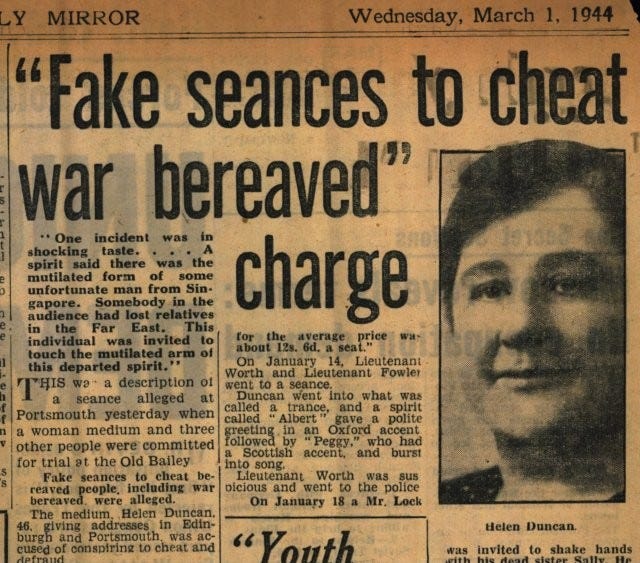
Of course, her supporters were many, and she managed to summon 45 witnesses to support a defence case paid for by the Spiritualists’ National Union, and they did her proud. By which I mean, talked a load of balls.
The defence argued that because she was for real, “she could not have acted fraudulently”. Unfortunately, she was tried under the Witchcraft Act of 1735, which “ensured that by conspiring even to attempt conjuration she would be found guilty” (Malcom Gaskill in ODNB again).
When the verdict was read out, there was further courtroom drama:
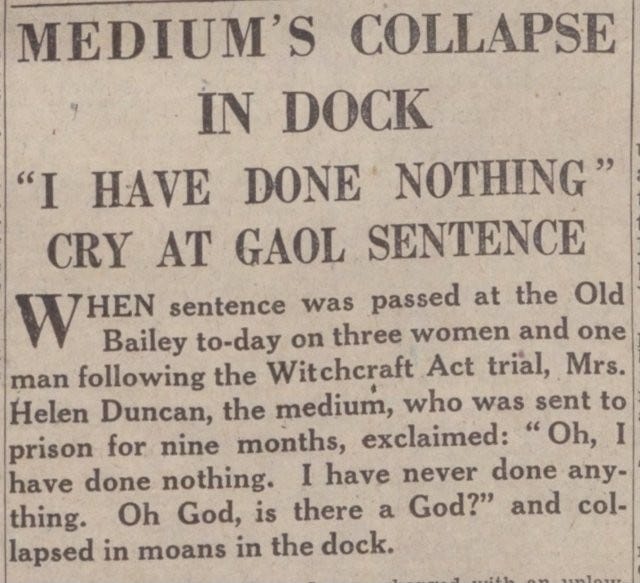
One remarkable turn of events, though, was that the Prime Minister got involved. Sort of. The entire country would have been aware of the trial, including Winston Churchill, but he thought it was all a bit excessive, and sent a memo to Herbert Morrison saying so:
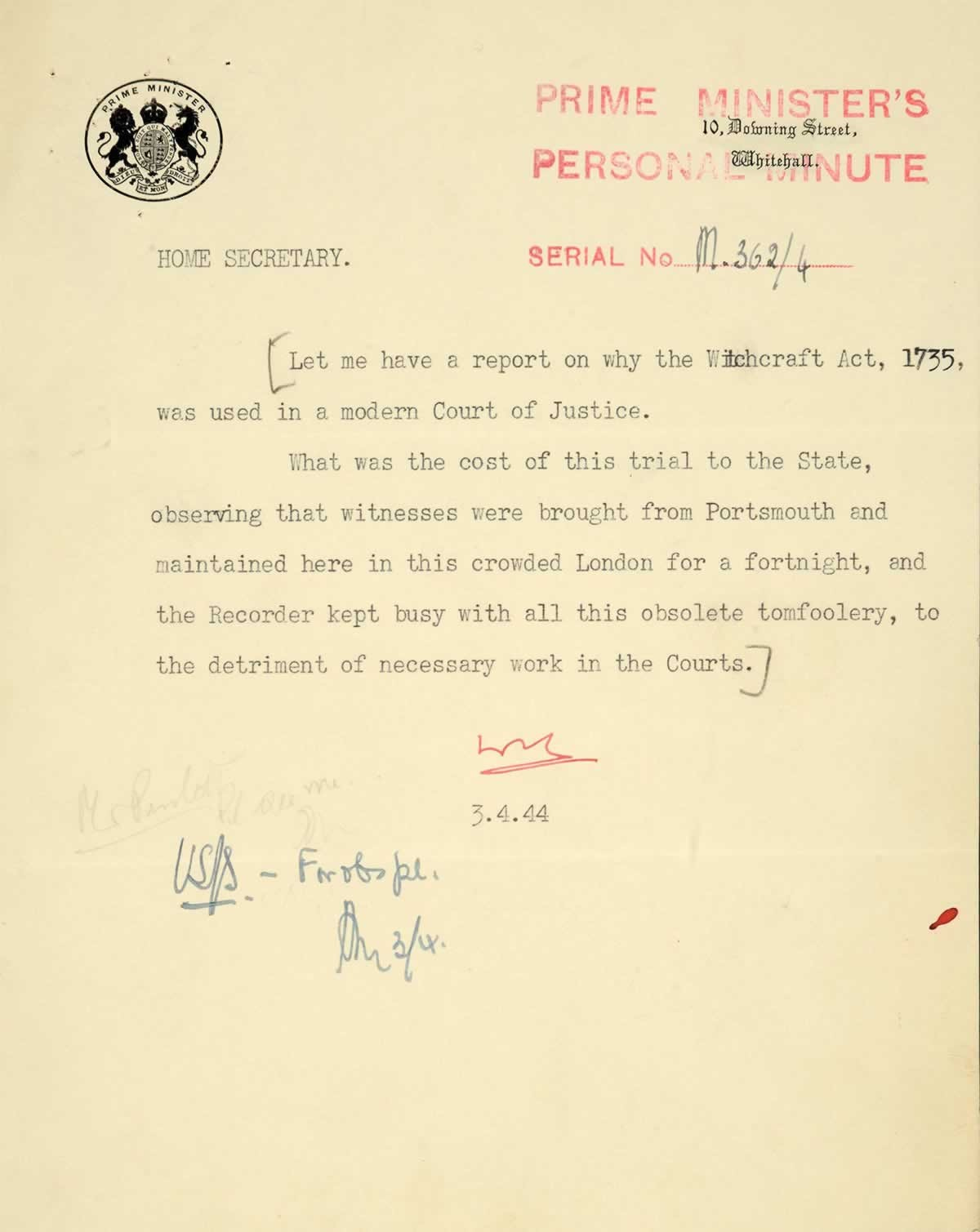
There is a legend that he was sufficiently interested in spiritualism to have had a private séance with Helen Duncan, but there isn’t a great deal of evidence for this. He clearly did think the use of a 209-year-old law was a bit silly/heavy-handed, though.
There are also those who argue* that Ian Fleming was involved in a conspiracy to convict her, because “Helen Duncan was giving out very accurate information ... D-Day was coming up and it was absolutely essential to keep the Allied deception plans intact.”
(*not very convincingly)
Interestingly, although she’s often said to be the last woman convicted of witchcraft, she isn’t. That was Jane Rebecca Yorke, after D-Day, in September 1944, but because she was 72 and frail, she just got a fine. Helen was the last woman imprisoned for it.
In 1951, the Witchcraft Act was finally repealed and replaced by the Fraudulent Mediums Act. You’ll find more about Duncan on JSTOR (and most of the images are from the National Archives), but one of the most interesting things you’ll read about her is by Hilary Mantel, reviewing Gaskill’s book Hellish Nell: Last of Britain’s Witches in the LRB.