Knicker nicker nicked
16 May 1975

(Yes, I am posting this a day late. Sorry.)
It’s the 51st anniversary today of one of the most marvellous examples on record of life (almost) imitating art, when far-right wanker Colin Jordan, former chairman of the ‘British Movement’, was up in court for stealing ladies’ underwear from Tesco
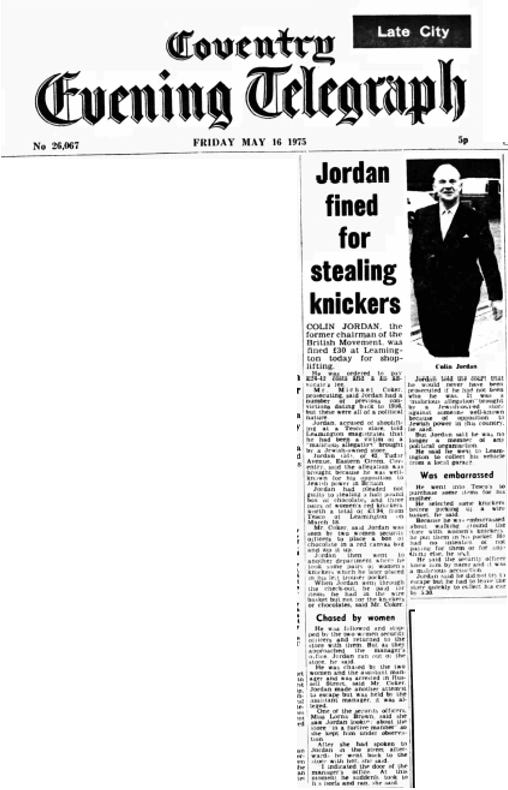
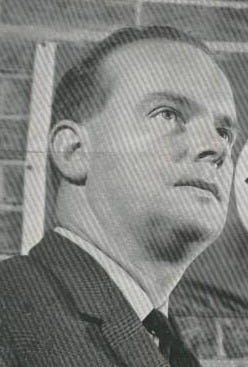
The story is fun in its own right: a leading light of the post-war British neo-Nazi movement getting done for nicking red knickers, rendering himself in one short moment a figure conjuring not fear but absolute ridicule. And Colin was an entirely horrid little man. He founded the National Socialist Movement on what would have been Hitler’s birthday in 1962, and I’ve cropped this look-at-me-the-man-of-destiny photo of him to leave out a bust of Adolf and a massive fucking swastika
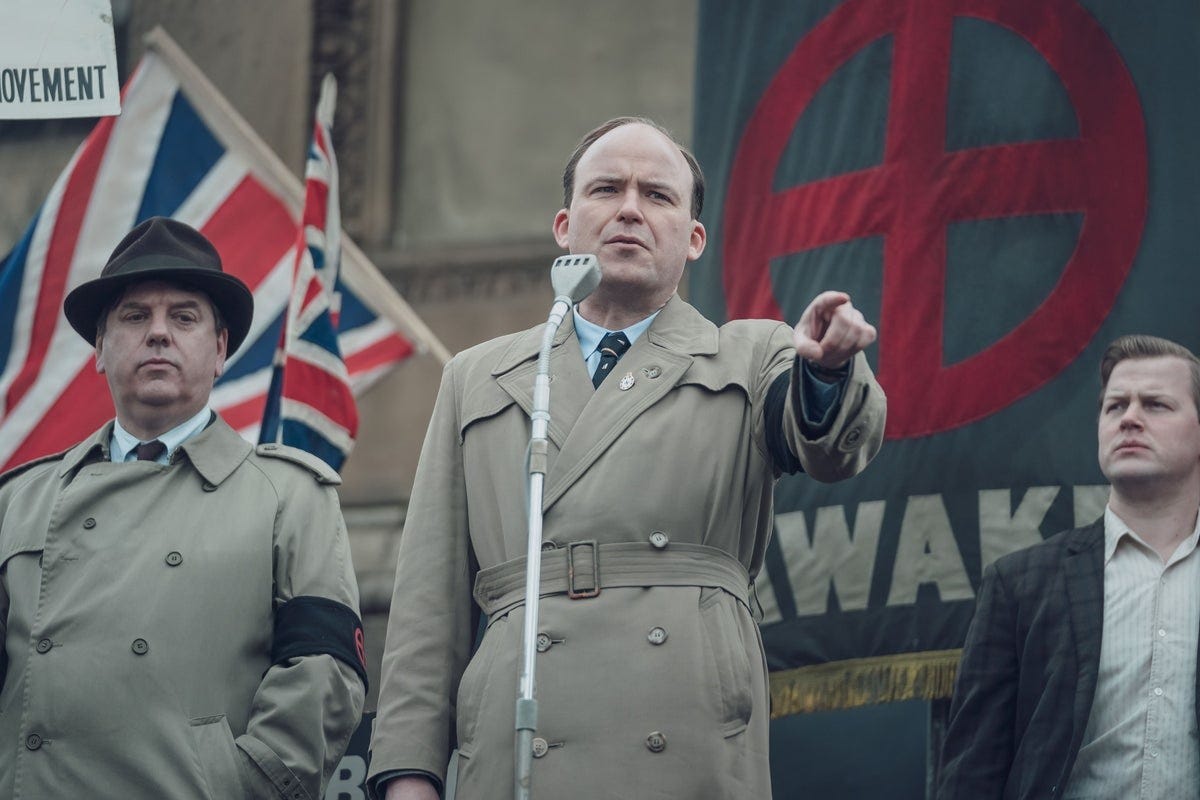
He’s who Rory Kinnear played in Ridley Road (the BBC series from 2021 about Jewish opposition to fascism in Britain), and he spent much of the 1960s and 70s fomenting racial hatred and sometimes being prosecuted for it
Before the knickers business, his best contribution to the gaiety of the nation was (according to my reading of his Telegraph obituary) getting lamped by one of the most senior and widely recognised Labour politicians of the 20th century :
During the 1960s Jordan regularly contested parliamentary elections, invariably losing his deposit. In 1965 he led a group of about 100 fascist demonstrators at a noisy by-election meeting at Leyton, east London. Denis Healey, then Harold Wilson’s Defence Secretary, who spoke in support of the Labour candidate Patrick Gordon Walker (who had lost his seat at Smethwick in the general election over immigration), scuffled with Jordan as he invaded the platform to harangue the crowd. Healey landed a heavy punch, knocking Jordan off the stage and sending him crashing into a watching journalist, breaking the reporter’s spectacles.
Pity about the journalist’s glasses, but otherwise, I think we can all agree: Denis Healey channelling Indiana Jones is a mental picture that does not disappoint. Other joyous images can be found in accounts of his Tesco knickers adventure. It may start prosaically...
Jordan was seen by two women security officers to place a box of chocolate in a red canvas bag and zip it up. Jordan then went to another department where he took some pairs of women’s knickers which he later placed in his left trouser pocket. When Jordan went through the check-out, he paid for items he had in the wire basket but not for the knickers or chocolates.
...but soon picks up
Chased by women
He was followed and stopped by the two women security officers and returned to the store with them. But as they approached the manager’s office. Jordan ran out of the store, he said. He was chased by the two women and the assistant manager and was arrested in Russell Street, said Mr. Coker. Jordan made another attempt to escape but was held by the assistant manager, it was alleged. One of the security officers. Miss Lorna Brown, said she saw Jordan looking about the store in a furtive manner” so she kept him under observation. After she had spoken to Jordan in the street afterwards he went back to the store with her, she said. “I indicated the door of the manager’s office. At this moment he suddenly took to his heels and ran, she said.
Having been caught, of course, he saw the error of his ways and put his hands up to it? Hahaha, no. He said he was buying the knickers for his poor, frail, old mum, and put them in his pocket because he was embarrassed. But also...
Jordan told the court that he would never have been prosecuted if he had not been who he was. It was a malicious allegation” brought by a Jewish-owned store against someone well-known because of opposition to Jewish power in this country, he said.
Yes, it was (((them))). Well, of course it was. The court didn’t buy it, strangely – and nor did his erstwhile followers. In his book Colin Jordan and Britain’s Neo-Nazi Movement – Hitler’s Echo, historian Paul Jackson says:
This detail would backfire though, further discrediting him in the eyes of some within the movement, who questioned his commitment to the cause if he was willing to enter such a Jewish-owned store. A spokesperson for Tesco, meanwhile, was quoted in the Sun newspaper: ‘If Mr Jordan thought we would frame him for his views, why, if he is so flagrantly anti-semitic did he come to our store in the first place?’ The Sun’s headline for the story typified the tabloid treatment of him too: ‘Pantie Thief Jordan’. Though he had been the subject to tabloid ridicule in the past, this was a new low.
If you’ve read a certain joyful 1930s comic soufflé in which Bertie Wooster encounters would-be dictator and at least initially fearsome foe, Roderick Spode, you may not need me to tell you why life is imitating art here. (If you haven’t read it, there are spoilers in what follows.)
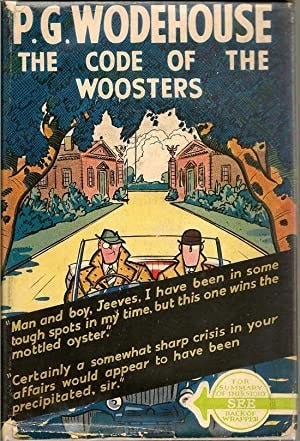
Spode is the leader of the Blackshorts – because when he went to get uniforms for his followers, the shops were all out of black shirts. He is mocked from the start, but we’re in no doubt that he could do Bertram W some serious damage.
He was, as I had already been able to perceive, a breath-taking cove. About seven feet in height, and swathed in a plaid ulster which made him look about six feet across, he caught the eye and arrested it. It was as if Nature had intended to make a gorilla, and had changed its mind at the last moment. But it wasn’t merely the sheer expanse of the bird that impressed. Close to, what you noticed more was his face, which was square and powerful and slightly moustached towards the centre. His gaze was keen and piercing. I don’t know if you have even seen those pictures in the papers of Dictators with tilted chins and blazing eyes, inflaming the populace with fiery words on the occasion of the opening of a new skittle alley, but that was what he reminded me of.
That’s their first meeting. Later on, Spode is advancing on Wooster with malice aforethought, but Jeeves has discovered that
The subject of Eulalie, sir, is one which the gentleman, occupying the position he does in the public eye, would, I am convinced, be most reluctant to have ventilated.
Bertie duly deploys the verbal grenade, and...
‘One minute, Spode,’ I said quietly. Just one minute. Before you start getting above yourself, it may interest you to learn that I know all about Eulalie.”
It was stupendous. I felt like one of those chaps who press buttons and explode mines. If it hadn’t been that my implicit faith in Jeeves had led me to expect solid results, I should have been astounded at the effect of this pronouncement on the man. You could see that it had got right in amongst him and churned him up like an egg whisk. He recoiled as if he had run into something hot, and a look of horror and alarm spread slowly over his face.
At this point, though, Bertie – and the reader – is in the dark. We only know the name Eulalie. Nothing else. We don’t know why it strikes terror into the hearts of near-gorillas who would be dictators. Until, finally, Jeeves tells all…
‘Mr Spode designs ladies’ underclothing, sir. He has a considerable talent in that direction, and has indulged it secretly for some years. He is the founder and proprietor of the emporium in Bond Street known as Eulalie Sœurs.’
‘You don’t mean that?’
‘Yes, sir.’
‘Good Lord, Jeeves! No wonder he didn’t want a thing like that to come out.’
‘No, sir. It would unquestionably jeopardize his authority over his followers.’
‘You can’t be a successful Dictator and design women’s under- clothing.’
‘No, sir.’
‘One or the other. Not both.’
‘Precisely, sir.’
So, it’s not a case of life matching art to the letter, but it is a historical echo which brings much pleasure. It doesn’t apply universally, sadly, but it does illustrate one incontrovertible truth: would-be dictators can deal in scorn, but they can never take it.