Odd this day

10 February 1890
It’s the 136th anniversary of some highly prized artefacts from Ancient Egypt being auctioned in Liverpool. From there, the 180,000 mummified cats in question went to their splendid and dignified final resting place.
They were ground up and used for fertiliser.
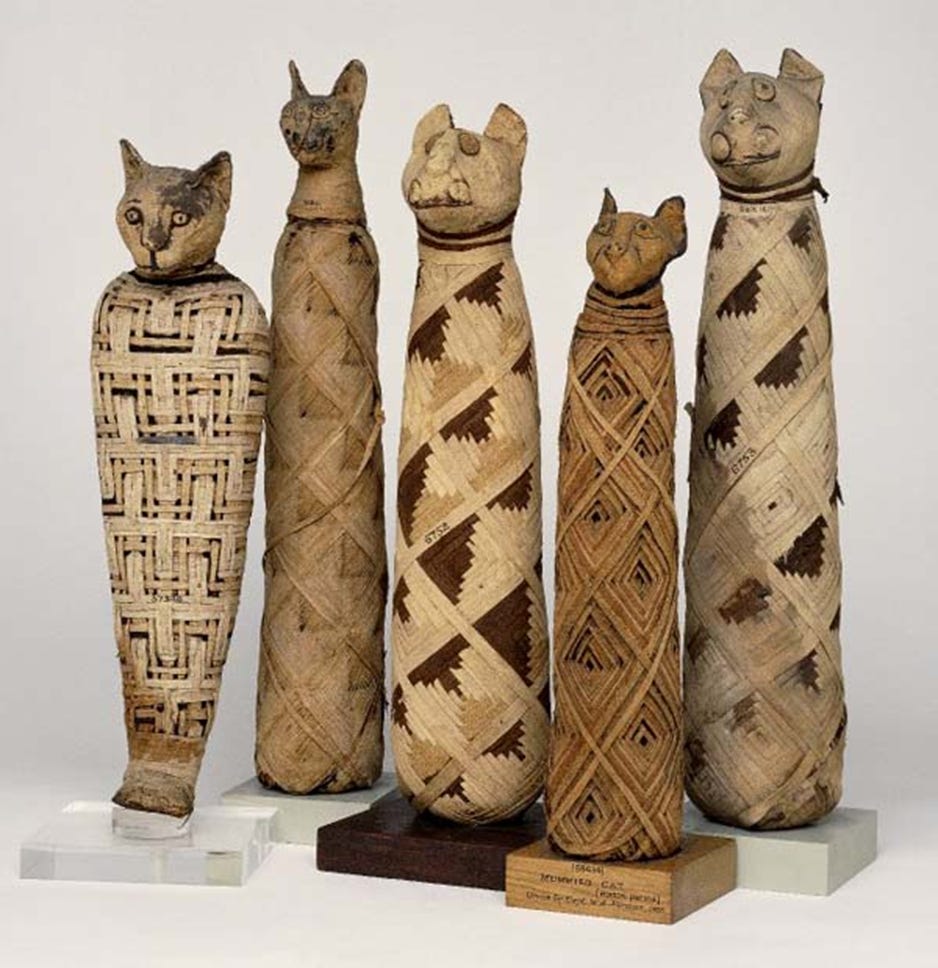
According to William Martin Conway’s Dawn of Art in the Ancient World: An Archaeological Sketch, our story starts two years earlier, in 1888, when a farmer (either during the normal course of his business, or while illicitly digging for ancient treasure) stumbled upon a rich seam of long-dead, once-worshipped felines.
For three or four thousand years the cat-mummies of Beni-Hasan lay undisturbed, awaiting the resurrection; now a resurrection has come to them, but other than they looked forward to. The archangel that heralded it was an Egyptian fellah from the neighbouring village. By some chance one day this genius dug a hole, somewhere in the level floor of the desert, and struck — cats! Not one or two here and there, but dozens, hundreds, hundreds of thousands, a layer of them, a stratum thicker than most coal-seams in a series of pits ten to twenty cats deep, mummy squeezed against mummy tight as herrings in a barrel.
William may have found it exciting, but this sort of digging was problematic. Press reports in January 1890 about damage to tombs led to a question in the House of Commons on 25 February about
some person unknown … systematically mutilating the tombs of Beni Hassan.
The unbothered Conway says:
The plundering of the cemetery was a sight to see, but one had to stand well to windward … The path became strewn with mummy cloth and bits of cats’ skulls and bones and fur in horrid profusion, and the wind blew the fragments about and carried the stink afar.
This was because
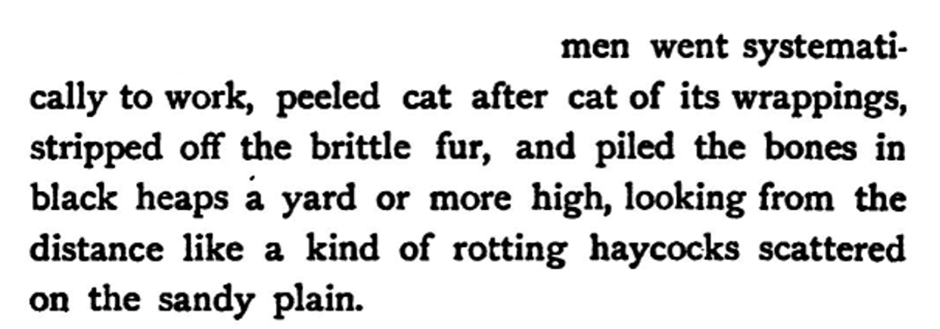
He acquired three bronze cats from the site himself, including one which actually contained a mummified cat, plus “one or more bronze statuettes of Osiris, god of the dead”.
Everything else, some of it “caked together in black lumps” was flogged to Leventon & Co and stuck on two ships. Apparently, 180,000 mummified cats weigh in at around 19.5 tons, although that’s based on contemporary news report, and as archaeologist/author Chris Elliott points out, we may not be entirely able to to rely on their versions of events. None of them seem terribly sure when the auction(s) took place, or the price(s) paid. I’ve opted for today because some of the papers (including the Bristol Mercury and Daily Post, below) reported on 11 February 1890 that the sale was “yesterday”, but Elliott thinks there were two sales, one of which may have happened several days earlier. (It does look quite likely that one was on 10th, though.)
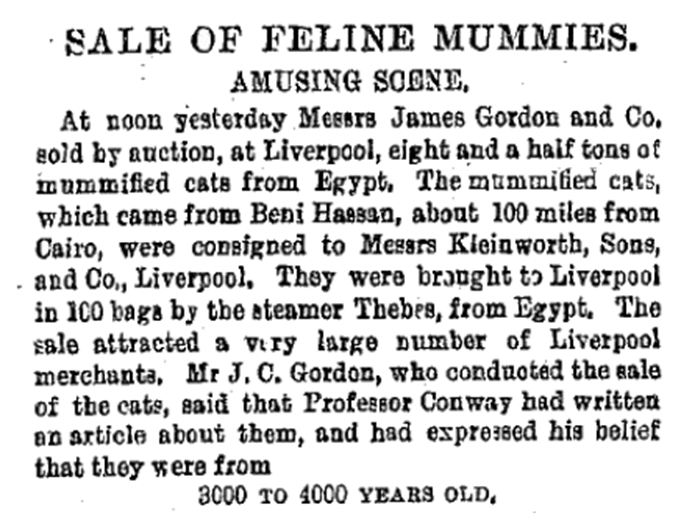
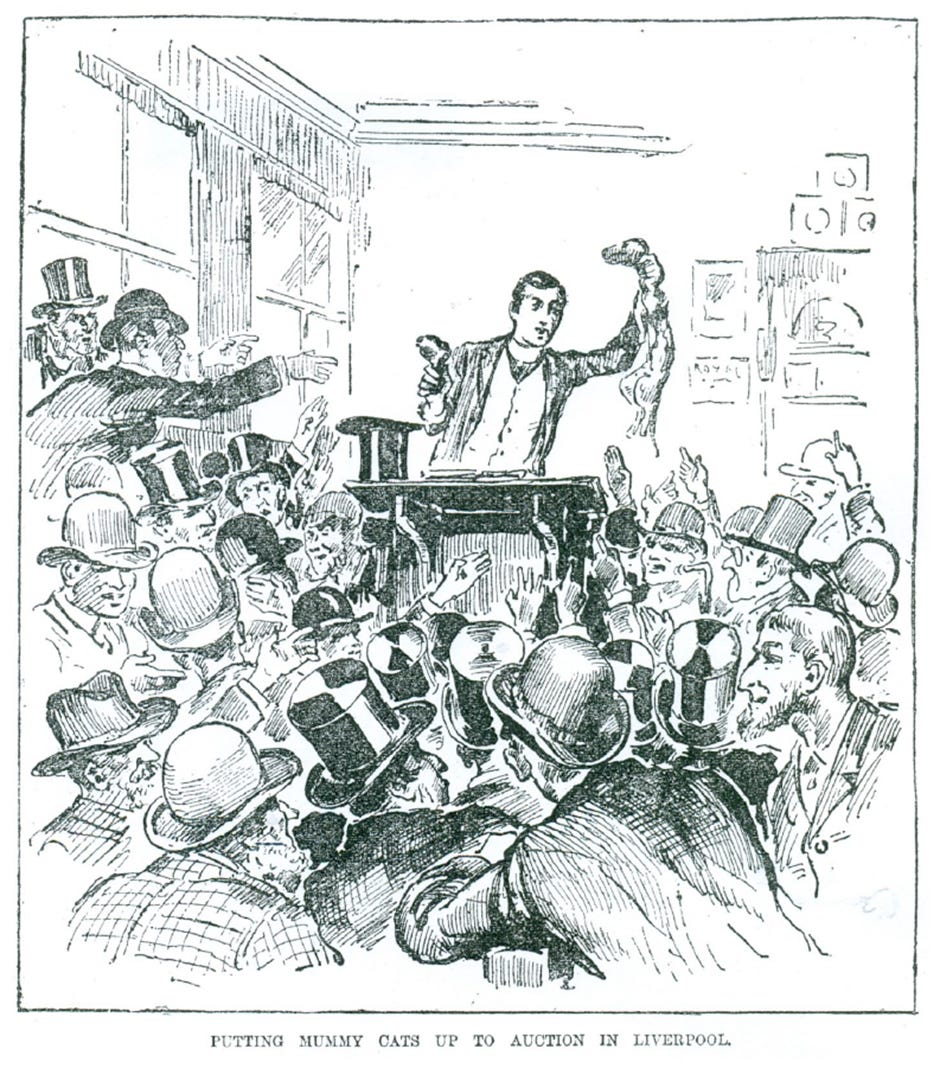
Whatever the truth is, the media had a lot of fun with it, and the mood of the coverage may have come from the atmosphere in the saleroom, where (the Leicester Chronicle said) the auctioneer had used the head of one of the mummies as his hammer (pictured in this Daily Graphic illustration).
The Bristol Mercury said the sale “from first to last evoked great merriment”, although there was a contrast between “the interest with which a few men of science looked upon the business as opposed to the banter indulged in by men of business”.
Punch ran a cartoon showing ghost cats emerging from the fields:
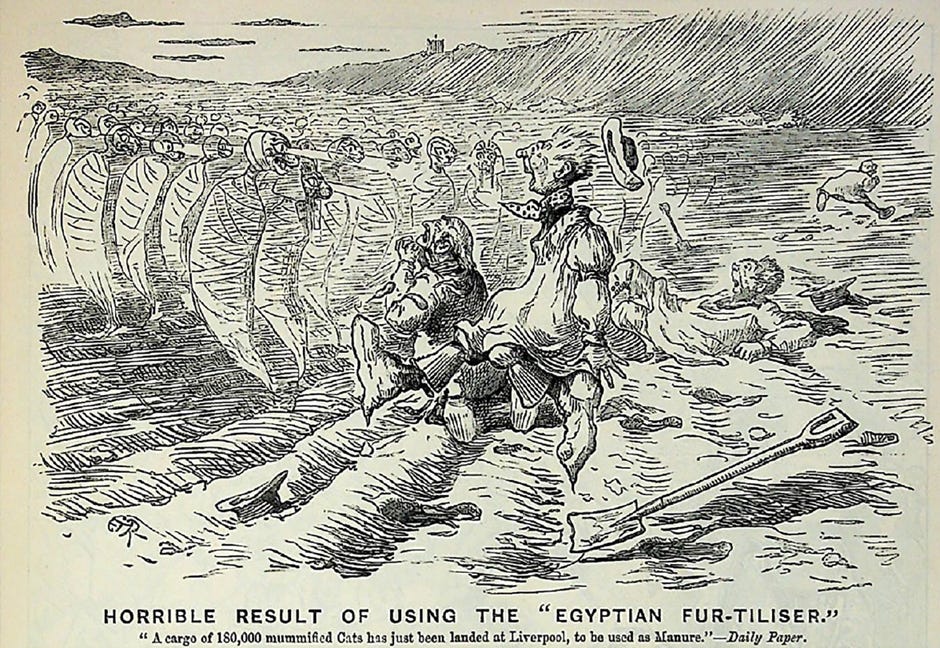
…and said the
rich fields of turnips and mangolds that will spring from the desiccated skeletons … will in turn become prime beef and mutton … What a journey … from Egyptian CHEOPS to London Chops!
…which rather suggests that all those people who used to question, when it was in its death throes, whether Punch was ever funny, might have had a point.
What’s especially weird and slightly nasty is that this isn’t even the most appalling recorded use of mummified creatures. There used to be a paint colour called ‘mummy brown’, which was not, as a sensible person might expect, intended to resemble the colour of a long-dead corpse. No. As Victoria Finlay notes in her book Colour — Travels through the Paintbox:
it was, as its name promised, made of dead ancient Egyptians. In her book Artists’ Pigments c.1600–1835, Rosamund Harley quotes from the journal of an English traveller who in 1586 visited a mass grave in Egypt. He was let down into the pit by a rope, and strolled around the corpses, which were illuminated by torchlight. He was a cool customer, and described how he ‘broke off all parts of the bodies and brought home divers heads, hands, arms and feete for a shewe’. Mommia was a thick bitumen-like substance and was apparently excellent for shading, although no good as a watercolour.
And the finite supply of dead ancient Egyptians needn’t be a problem…
If the suppliers ran out of Egyptian brown, they could always make their own. In 1691 William Salmon, a ‘Professor of Physick’ working out of High Holborn, gave a recipe for artificial mummy, as follows: ‘Take the carcase of a young man (some say red hair’d) not dying of a Disease but killed; let it lie 24 hours in clear water in the Air: cut the flesh in pieces, to which add Powder of Myrrh and a little Aloes, imbibe it 24 hours in the Spirit of Wine and Turpentine…’ It was a particularly good remedy for dissolving congealed blood and expelling wind ‘out of both Bowels and Veins’, he said.
But all this is as nothing to what ancient Romans and, indeed, people up to medieval times would do with wrapped corpses. Pliny the Elder
…and people agreed with this assessment for centuries, even though
as one would expect, the ingestion of ancient, powdered human remains caused horrendous consequences for the majority who consumed them.
Another book, Kassia St Clair’s The Secret Lives of Colour, says Pliny favoured using ground-up dead people “as toothpaste” and “Shakespeare’s son-in-law used it on a troubling case of epilepsy”, while Francois I of France “carried a little pouch of powdered mummy and rhubarb on him at all times”. But she also says there may not even have been any bitumen in the things:
The Persian word for bitumen was mum or mumiya, which had led to the belief (along with the fact that mummified remains were very dark) that all mummies contained the substance.
Anyway, in the 19th century, artists finally began to cotton on to the connection between the name ‘mummy brown’ and its source. Pre-Raphaelite Edward Burne-Jones interrupted the lunch where he found out to rush home, horrified, get his tube and
insisted on our giving it a decent burial there and then.
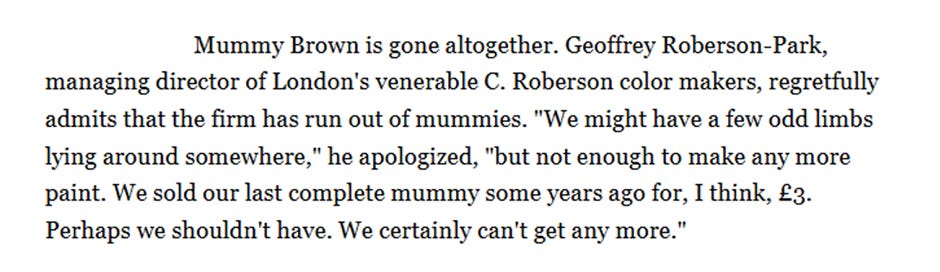
It was used so little by the 20th century that Time magazine reported in 1964:
Yes, this has all been a bit rambling and disgusting, but at least now we have some idea why that Imhotep guy had all that ooze on him.