Odd This Day: camp performances
22 March 1944

On this day in 1944, The Sketch reported that Noël Coward’s Post Mortem, set during WWI, had had its world premiere during WWII. The lead character’s mother was played by… er, Brian McIrvine. Why? Well, the show took place in Oflag VII.b, a POW camp in Eichstätt.
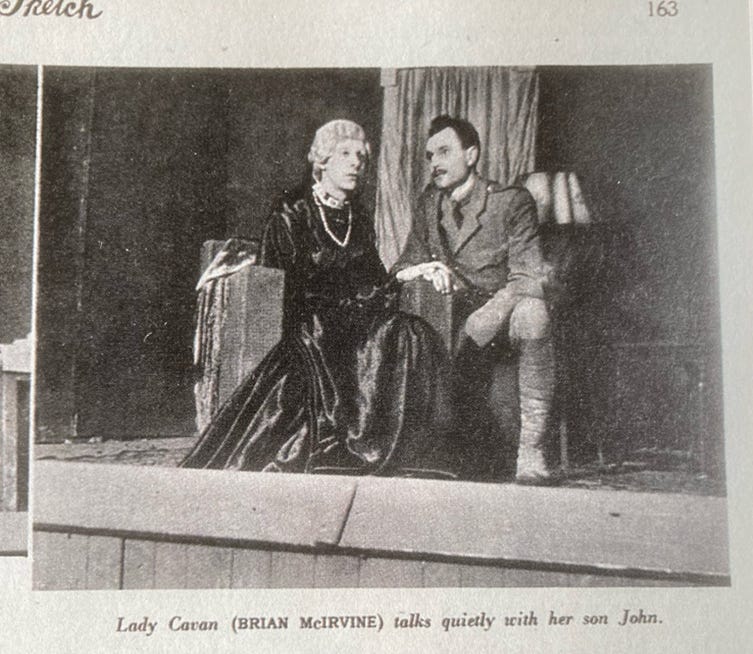
Here’s young Brian in another scene, in which he plays John Cavan’s former fiancée Monica Chellerton, while John Peacock, standing stage left, plays not Graham Chapman but ‘Kitty Harris’.
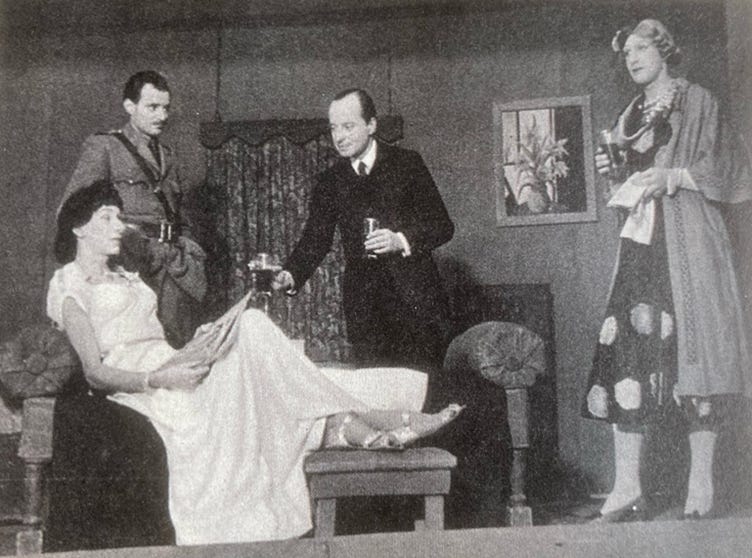
According to the Sketch, “Coward gave them special permission to perform [it]”. He’d decided, after writing it — immediately after Private Lives, intriguingly — that it wasn’t good enough to put on (and he may have had a point. When it was first done professionally, in 1992, it got mixed reviews.)
What’s most important about this, though, is not the relative strengths of Coward’s plays. No. Clearly, it’s military chaps in frocks – something which has occupied Proper Historians. Not least because there was a lot of it about at the time. This wasn’t the only Coward play to be staged in a POW camp. Not by a long way. According to historian Clare Makepeace in History Today, the chaps liked Blithe Spirit best.
This comic play was a favourite among POWs and, in September 1943, it was put on at Campo PG 78, in Sulmona, central Italy. It had a run of ten performances before being interrupted by the Italian armistice, after which all but one of its cast ended up in Germany. Shortly after the war in Europe ended, a ‘Special POW Matinee’ of this production was staged at the Duchess Theatre in London’s West End in July 1945.
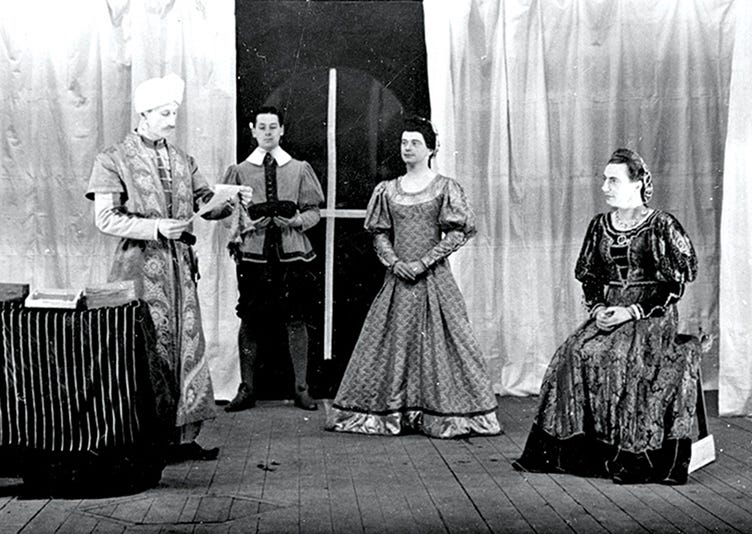
…and it was far from the only show that the B! O! B, O, Y, S, boys to entertain YOU put on. The Imperial War Museum has a splendid photo in its archives of a theatrical production at Stalag Luft III in Poland.
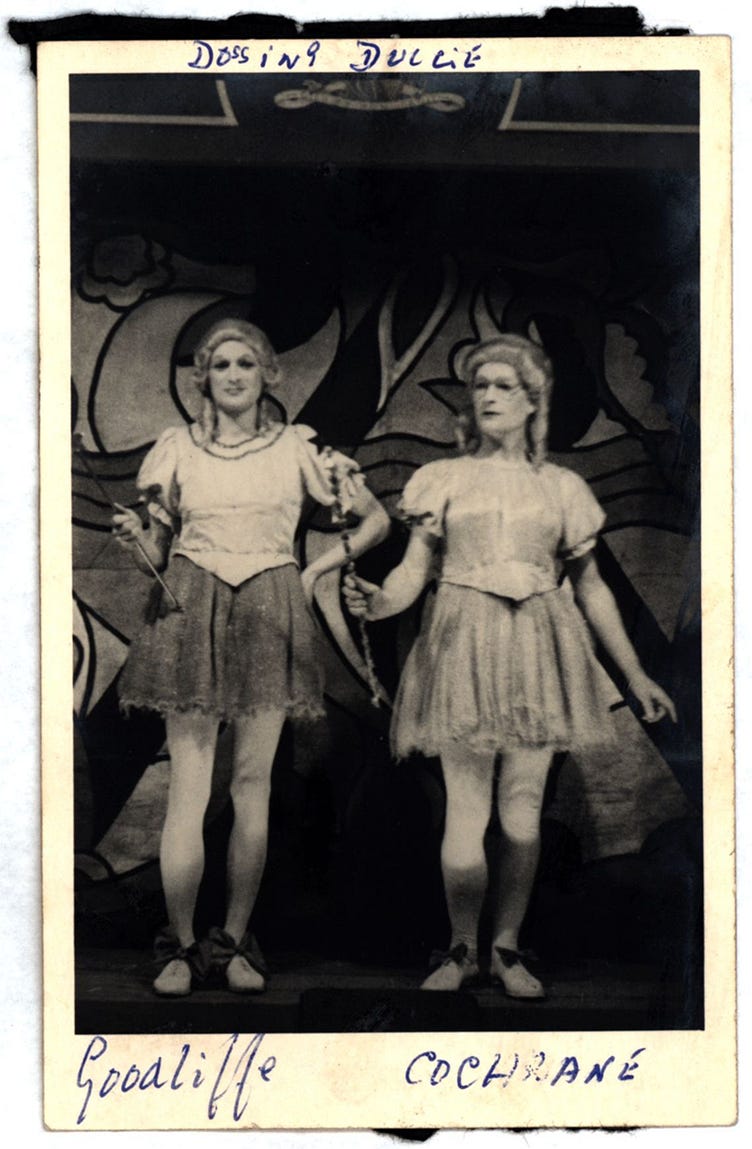
King’s College Cambridge has an archive of materials (thanks to one of its post-war librarians, who studied there pre-war, and was a prisoner during the conflict in three camps, including Oflag VIIb). Their trove includes a shot of a pantomime called Dossing Dulcie.
Not only were these shows allowed in POW camps, they were
done with the support and aid of the German authorities. Perhaps the Germans felt that if the prisoners were busy with concerts and variety shows they would think less about digging tunnels.
The men who took on the female parts went to great lengths to be convincing, learning how to “walk toe to heel, take small steps, and slide gracefully into chairs”. Indeed, their dedication went further than that…
Cast members had to have their ‘unsightly masculine limb’ shaved, eyebrows plucked, hair on their head grown long, and were made up with greasepaint, cosmetics and nail varnish.
Costumes were made from sheets, white shirts, mosquito netting, or “clothing from private parcels sent … from home” (Oh, aye? “Dear Mum, you know that gold lamé number of yours…?”)
One wig “was ingeniously created strand by strand from Red Cross parcel packing”. Even if the… ~ahem~ camp authorities were supportive, though, the level of assistance enjoyed at Oflag VA seems remarkable.
POWs also created costumes through other means. At Oflag VA, a camp for officer POWs at Weinsburg in south-west Germany, where the men reportedly had good relations with their captors, clothing for the pantomime Puss in Boots was loaned from an opera company in nearby Stuttgart. They gave the camp a complete set of wigs, hats, dresses and stockings for every part, which POWs supplemented with garments of their own, such as pyjamas, trousers, pullovers and socks.
As Clare Makepeace says in her book Captives of War, the idea was mimesis, or convincing imitation, not mimicry, which is
imitation with … the aim of creating a comic effect, as exemplified by the pantomime ‘dame’, who appears oversized and clumsy.
And convince they pretty much did. One man, Captain Jon Mansel, wrote of Brian McIrvine (who was a professional actor, to give him his due):
I’m bloody sure if he was billed as a girl at a London Theatre no-one would question her sex. It’s unbelievable.
But perhaps none was ever as convincing as Don ‘Pinky’ Smith, described as “gorgeous” by Corporal Jack White after seeing him in Up The Pole at Stalag 383 in May 1944.
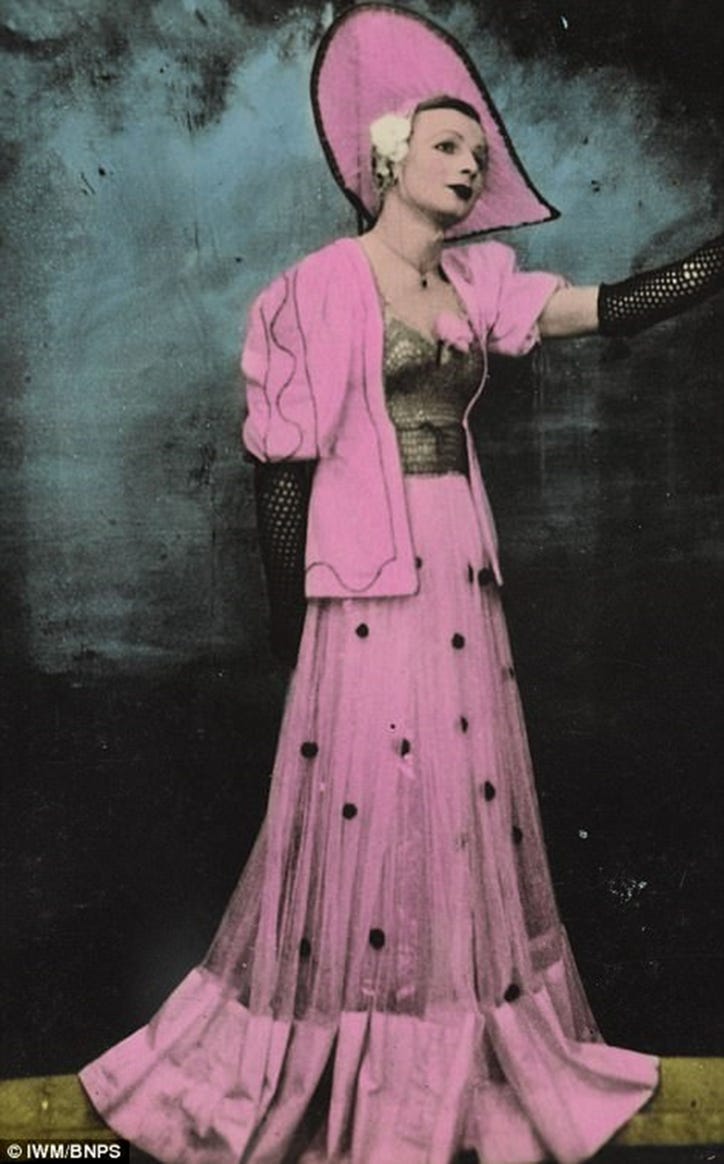
Makepeace says that
according to White, 14,000 orders were placed for a copy of the image: an extraordinarily large number for a camp that contained approximately 4,700 prisoners.
Stalag 383 was also a camp which staged dances every Wednesday and Saturday, and Sergeant Major Andrew Hawarden confided in his diary that
several lads dress as ladies to give it a proper atmosphere.
Not that there’s anything we need to discuss when it comes to men in single-sex institutions. Good heavens, no.
One final point, though: if Blithe Spirit was one of their favourites, someone must have played Madame Arcati. I’m sorry to have to inform you that I didn’t come across any photos of that. If you know, or are, an Imperial War Museum archivist, do get in touch.
What a fascinating essay…and wonderful photographs…thank you!