Odd this day

2 February (every year)
So, Groundhog Day — is it a uniquely weird Pennsylvanian custom? Apparently not! If you look into odd (and not even just English-speaking) folklore and customs, it’s got precursors…

2 February is Candlemas Day, a Christian holiday, but also Badgers’ Day in Huntingdonshire — according to a 20th century local historian/ archaeologist type called C F Tebbutt.
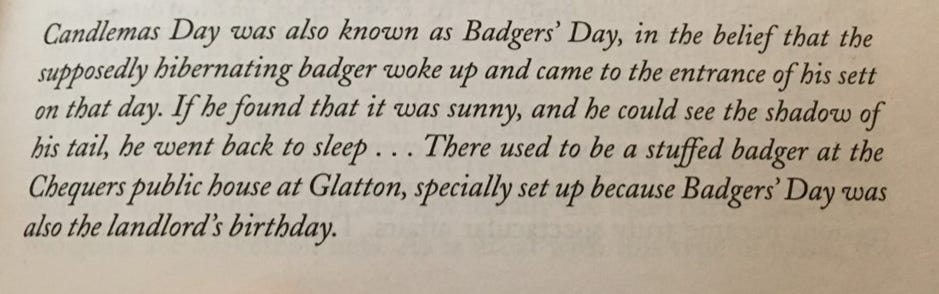
That’s from Steve Roud’s The English Year — A month-by-month guide to the nation’s customs and festivals, from May Day to Mischief Night, which I can recommend highly.
It’s also Hromnice (HROM-nyi-tseh) Day, according to Czech folklore, which suggests that if the sun shines today, there will be six more weeks of winter — and that
if as little snow falls as can be noticed on a black cow, the year will be fertile.
Righto. Another Czech saying is that if Hromnice is warm, the bear builds himself a shed, and if cold, the bear tears down his shed — begging the question: if he only builds the shed when it’s warm, where the hell does this cold weather shed come from? Is it a shed left over from the last time the weather was warm, and — even if so — since when did bears go around with pencils behind their ears and issuing sharp intakes of breath when you say you’d like an extension some time this year?
Yes, that is silly, but it’s still more sensible than dropping and killing a celebrated rodent on Groundhog Day, though, ISN’T IT, BILL DE BLASIO?
Groundhog died week after New York mayor Bill de Blasio dropped it
Plus: a famously unread book!
It’s also the 102nd anniversary of the publication of Ulysses, which James Joyce celebrated by going to a restaurant and… er, looking miserable. According to Kevin Jackson’s Constellation of Genius — 1922: Modernism and All That Jazz, he and Nora and others toasted the book (and Joyce’s 40th birthday) “at Ferrari’s, one of his favourite restaurants”, where
Joyce wore a new ring — a treat he had long promised himself for the occasion. But there was no other sign of revelry in his behaviour; it was as if he were suffering from authorial post-natal depression. He looked gloomy and sighed, and said little; he ordered food but barely touched it; and he kept his copy of Ulysses in its wrapping paper until well after dessert, when he yielded to his guests’ demands and opened it on the table.
I can recommend Jackson’s book, which covers the other great upheavals in culture that year: T S Eliot’s The Waste Land, Louis Armstrong’s first gig with King Oliver’s band, Howard Carter discovering Tutankhamun’s tomb… but also gives you a picture of the rest of the publishing landscape, such as Agatha Christie’s second novel The Secret Adversary, and — the day after Ulysses — a collection of golfing stories…
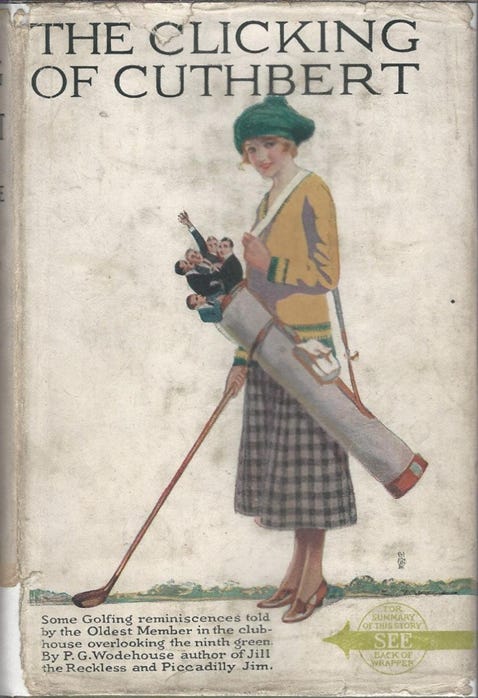
…which, much as I loved Dubliners, and admired Ulysses, was by a writer who has probably brought more pleasure to a greater number of readers than any other (and — sorry Jimbo — certainly more than Joyce).