Ooh, I was in bits
21 May 1650

It’s the 376th anniversary of the hanging, drawing and quartering in Edinburgh of James Graham, the 1st Marquis of Montrose, after which it took him 11 years to get a funeral – partly because of the English Civil War, and partly because parts of him had been distributed for nailing up in Aberdeen, Glasgow, Perth and Sterling. Some of his bits were restored to him before he went to his final, belated resting place. Others peregrinated about the world for centuries to come...
Our story starts in 1638 with the Covenanters – Scottish protestants who were loyal to the king but wanted to make it clear they didn’t want him interfering with their church. As historian Rachel Bennett put it, they were a bit put out when
Charles I alienated his Scottish subjects by reforming the liturgy and discipline of the church, leading to fears of an eventual return to popery.
(Rather marvellously, for fans of academic titles, that comes from her chapter of a 2017 book called Interdisciplinary Perspectives on Mortality and its Timings – When is Death?)
Montrose was one of the original signatories, but met the king the following year to discuss religion, and “began to switch his allegiances” – at least partly because
the governance of Scotland was increasingly in the hands of certain individuals, notably his great enemy the Marquis of Argyll, who he feared were committing the very breaches of the law for which they had previously condemned the King.
So, Montrose became (in the words of historian Richard Cavendish)
one of the most romantic figures in British history, [and] led a campaign of dashing brilliance as Royalist captain general in Scotland against the Covenanters and his bitter personal enemy, the Marquess of Argyll, in the summer of 1645. With a small swift-moving force of Highlanders and Irish, he ran audacious rings round his opponents until September, when he was finally pinned down and defeated by superior numbers at Philiphaugh in the Borders.
He skipped the country, and came back five years later to fight for Charles II, but this time luck was not on his side.
He failed to raise the clans in sufficient numbers and in April he was trapped and routed at Carbisdale. After wandering in the hills with the hue and cry out against him, so hungry that he was reduced to eating his gloves, he took refuge at Ardvreck Castle with Neil MacLeod of Assynt
Unfortunately, there was a bounty on his bonce, and (going back to Bennett) McLeod
handed him over to the Committee of Estates [the Covenanters] for a bounty. This perceived treachery fed into the Royalist cult of martyrdom in the wake of Montrose’s death.
Montrose asked to be killed there and then, but McLeod refused, and the Committee decided to make an example of him and turn his execution into
a three-day long public spectacle replete with all possible ignominy
...although they also scheduled it quickly to make sure it happened
before King Charles II arrived in Scotland and interceded to prevent the execution.
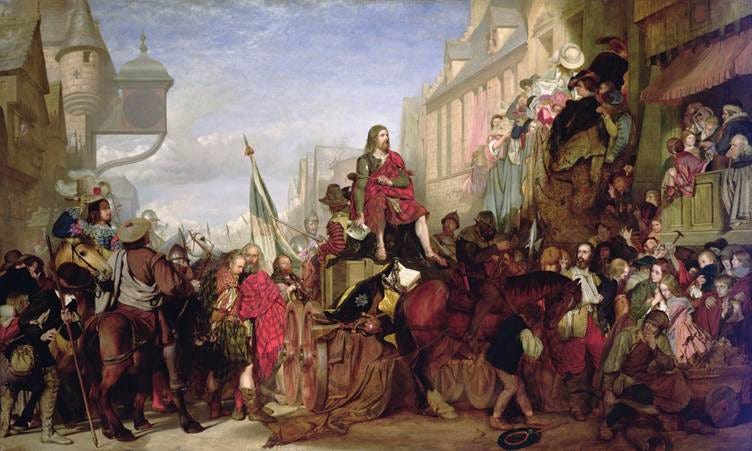
He reached Edinburgh’s city gates on 19 May, and was taken to Old Tollbooth (a municipal building and jail) on a cart. The journey of less than half a mile took three hours, because they stopped many times along the way – especially outside Argyll’s house – so the crowds could jeer and throw things at him as instructed. Largely, they remained silent, although some sources say many wept.
He spent the next day, a Sunday, in his cell, being badgered by Presbyterian ministers to repent. On the Monday morning, the 21st, according to History Today:
Montrose rose for the last time on earth and made himself ready. Carefully combing out his long hair, he was reproached by one of the Puritan divines for paying so much attention to his appearance at such a time. “My head is still my own,” Montrose replied. “Tonight, when it will be yours, treat it as you please”.
So, you can see why he was seen as a heroic figure: not just the military prowess, but who doesn’t love a bit of insouciance in the face of death? Rachel Bennett says that apparently, on being told of the plan to cut him into bits and distribute them across the country, he said
that he thought it an honour to have his loyalty remembered in Scotland’s five most eminent towns.
...and also told a guard:
even after I am dead I will be continually present…and become more formidable to them [the Covenanters] than while I was alive
...which does, indeed, sound like an early example of:

Anyway, he was duly hanged and chopped up. His arms went to Aberdeen and Dundee, the legs to Stirling and Glasgow. He’d been excommunicated by the Covenanters in 1644, so his torso, instead of going to family for burial, was chucked in a wooden box in unconsecrated ground.
At the time, this final insult by the Scottish Kirk was considered a greater torture than the punishments inflicted upon his body in life.
In an irony he would have appreciated, when his head was taken off its spike after 11 years, it was replaced by that of the Marquess of Argyll, who had by then been found guilty of collaborating with Cromwell’s Protectorate and complicity in the death of the previous king.
His funeral in 1661 was lavish. Paid for by Charles II, it cost £802 – over £127,000 today – and was designed to bring old enemies together and display the new regime’s strength. The torso was dug up, processed through the streets, and reinterred in the High Kirk of St Giles. He was only reunited with one of his arms, though. The one that went to Aberdeen had been buried with fellow royalist George Huntly, 2nd Marquis of Gordon. It, too, got a procession in a velvet box through Aberdeen, before making the journey to Edinburgh for the funeral.
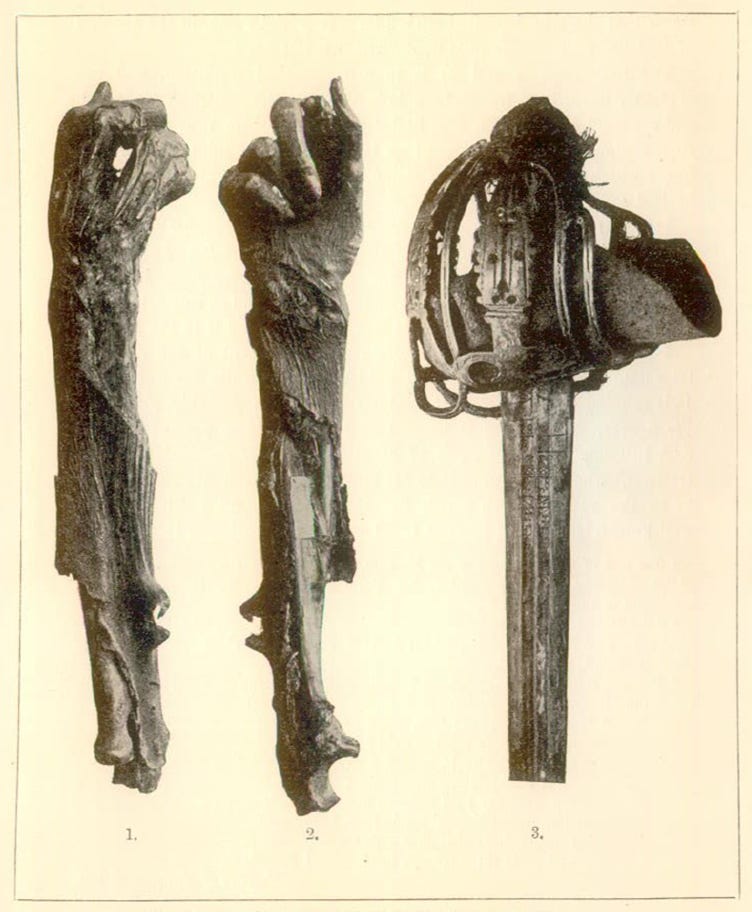
The right arm, which had been sent to Dundee to be nailed over the main town gate had been taken to England by one of Cromwell’s men. When one of his descendants moved to Spain in 1704, the arm joined an antiquarian collection in Leeds. When the collector died, a Yorkshireman bought it, and it pops up in historical records in 1752, 1834, and 1891, when it was bought by Mr. J.W. Morkill, who tried to sell it at Sotheby’s in 1925. After an outcry, it was withdrawn, and left to Morkill’s son seven years later, at which point it disappears into the mists of time.
The right arm’s journey wasn’t the most convoluted taken by a part of the old boy, though, because, when they dug his torso up in 1661, they discovered his chest had been opened and the heart taken out. His niece, Lady Napier, had ordered this, and had the heart embalmed and put in a gold filigree box (a gift from a Venetian Doge, apparently) which was itself put in a silver urn, which she sent to Montrose’s son, who was in exile in the Netherlands. There, at some point, it was lost, but a friend of the fifth Lord Napier spotted it in a Dutch collection of curiosities and bought it for him, and it went back to the ancestral pile for a spell. One of the later Napiers, though, was an officer in the East India Company, and off it went with him to Madurai in Tamil Nadu, where apparently the family treated it with such reverence that
the locals believed it to be a talisman with the power to protect the bearer in battle. Owing to this superstition, it was stolen and sold to a powerful chief.
Alexander Johnson, a descendant of Lady Napier, often hunted with the local chiefs, though, and formed a bond with the chief who had the heart – who didn’t know it had been stolen, so gave it back. The family went back to Europe in 1792, but this involved travelling through revolutionary France, so to avoid the precious metal being confiscated, they
entrusted the gold box into the safe keeping of an English woman in Boulogne named Knowles. When Knowles died soon after, the family were unable to trace the heart.
However, in 1931
Captain H. Stuart Wheatley-Crowe, the president of the Royal Stuart Society, led an investigation into the missing heart. Wheatley-Crowe had in his possession an embalmed heart that was believed to have been brought to England from France during the Revolution by the ancestors of the Perkins family who claimed it was the heart of Montrose. He had a medical examination carried out upon the heart that found it to be approximately 300 years old, but could find no other definitive proof of its authenticity. In 1951, Wheatley-Crowe sent the heart to Canada to a person he believed had a claim to the relic, a Mrs. Maisie Armitage-Moore.
Then (yes, I know, this is preposterous) in 2012
the largest ever collection of memorabilia marking the life of James Graham was exhibited in the Montrose Museum ... to mark the 400-year anniversary of his birth. The exhibition included paintings, documents, weapons, and a heart believed to be that of Montrose himself. The museum’s curator acknowledged that there were two recorded accounts of different hearts believed to belong to Montrose and they had located one. However, it is unclear if this was the same heart that had been sent to Canada in 1951.
And after all that, I couldn’t find anything at all about what happened to either of his legs. For all I know, Montrose is in his grave in the same state Douglas Bader is in his.