The Mad Major
5 May 1953

73 years ago today, Squadron Commander Christopher Draper DSC flew under 15 of London’s 18 bridges, prompting ‘Mad Major’ headlines – a nickname he’d earned by trying the same stunt 23 years earlier. He was 61, and wasn’t to lose his pilot’s licence for another 11 years.
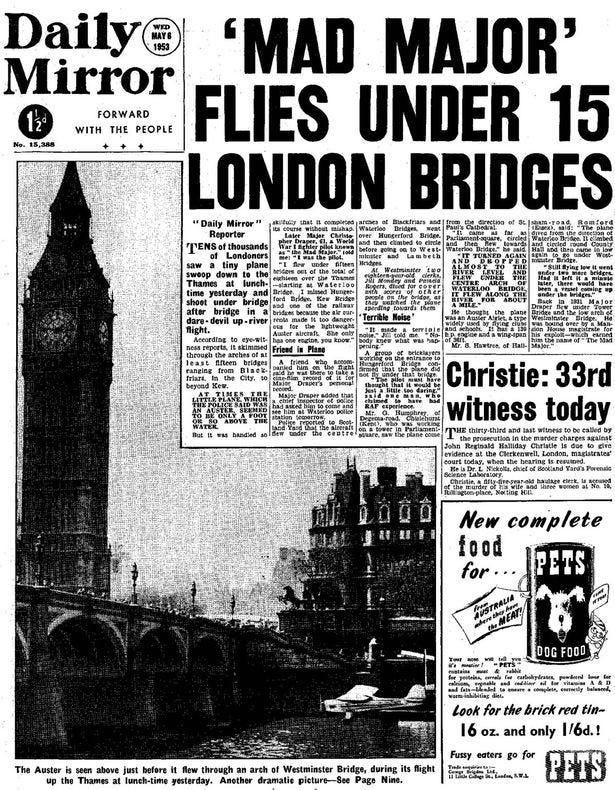
Draper had earned a Distinguished Service Cross and the French Croix de Guerre for his service in WWI, which involved shooting down nine German planes, and
hedgehopping across no man’s land to pepper the German trenches with bullets.
‘Hedgehopping’ means flying close to the ground (I had to look it up), and he was shooting at the enemy trenches not with a weapon mounted on the plane as you might imagine, but with
a .303 rifle, his Webley revolver, and anything else he could lay hands on.
Apparently, WWI was when he got his taste for dangerous stunts, because he once took a seaplane under the Tay Bridge, and flew under a bridge in France “accidentally” on the way to the front lines earning a huge cheer from watching troops. After the war, he was an unsuccessful second-hand car salesman and (according to one account) a wine taster, and spent some time as a test pilot – but, like a lot of veterans, struggled. So, in September 1931 he decided to advertise his talents and borrowed a DH.80A Puss Moth.
He flew it, twice, through the gap in Tower Bridge between the road and the upper walkway, and then under Westminster Bridge
to prove to the aeronautical world, and to satisfy myself, that, in spite of the lapse of 10 years, I am still the highly skilled specialist I used to be.
That was what he told the court, anyway. Apparently,
This somewhat shaky defence was good enough for the magistrate, and Draper got away with no punishment, but promised to be on his best behaviour for 12 months.
Some accounts say he was nicknamed The Mad Major for the bridge stuff in WWI, but the Telegraph says it was after this stunt – which makes sense if he was named after the 1921 march of that name by Kenneth ‘Colonel Bogey’ Alford (which seems more likely than Alford naming the tune after him). Anyway, the fame he earned got him stunt work in films, and eventually acting jobs.
When WWII came along, he joined up again and became an anti-submarine pilot, but by the 1950s was skint again. In 1931, bad weather had stopped him attempting more than two bridges, so...
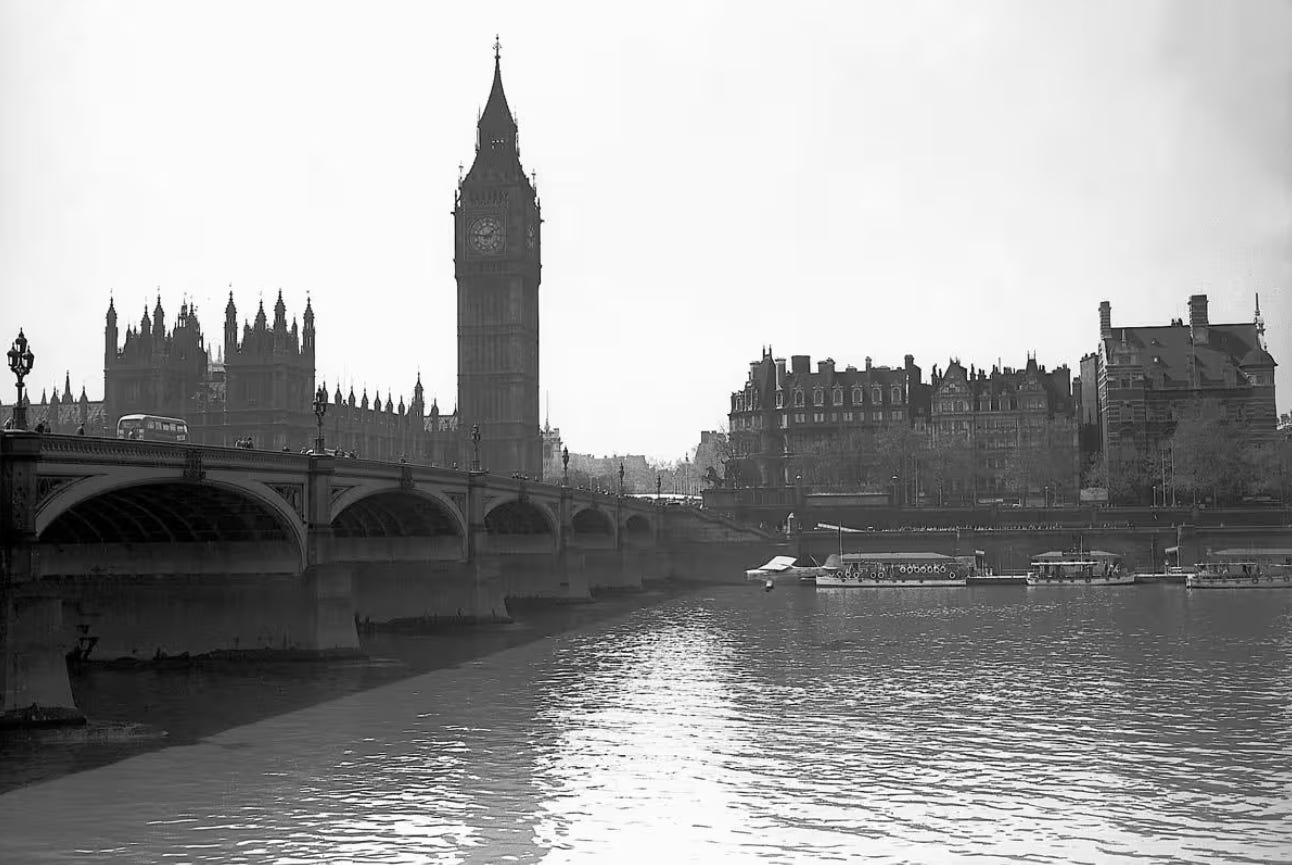
He rented a 100 horsepower plane and set off again. Time magazine’s account is slightly breathless and not altogether reliable, but one of the plausible bits says
Not one [bridge] is 50 ft. above the water yet the Mad Major flew his plane under arch after arch at 90 m.p.h.
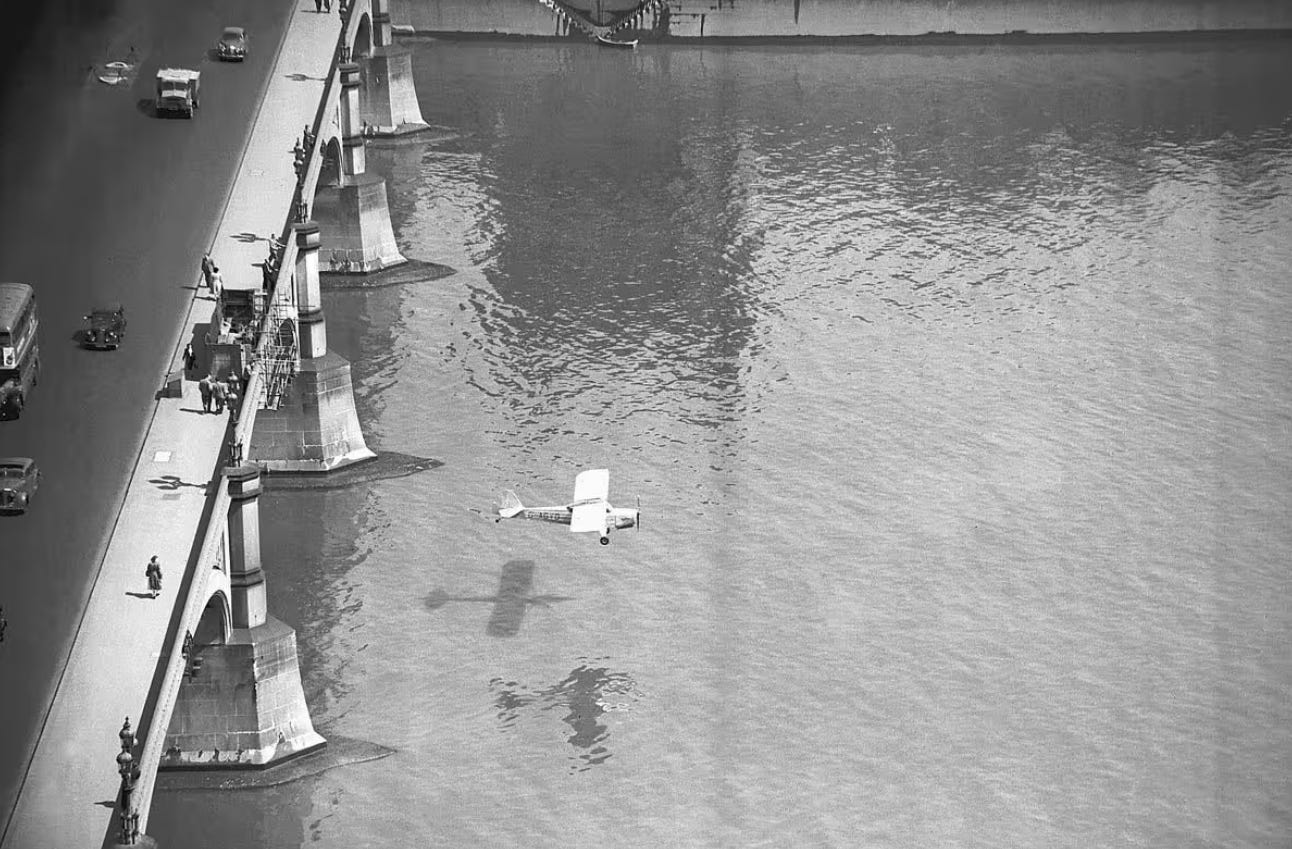
Depending on which account you read, he missed out Hungerford, Barnes and Kew bridges because “the rising currents were tricky ... I didn’t want to take any risks” or due to the “leisurely speed of the pleasure boats”, which got in his way.
He faced eight charges of dangerous flying, but was simply ordered to pay costs of ten guineas. “I did it for the publicity”, he said. “For 14 months I have been out of a job, and I’m broke. I wanted to prove that I am still fit, useful and worth employing.” It worked: he (and other ageing veterans) got job offers.
What’s extraordinary is this might not have been the most interesting thing he did. Between the wars, because he was always complaining about how the government treated veterans, the Nazis identified him as someone who might be useful to them.
In 1932, he was invited with other WWI flying aces to meet their German counterparts – and also met Hitler. Back in Britain, he was invited to a German doctor’s house in Wimbledon, and
By about 4pm, Draper began to suspect something was afoot, and asked the doctor if he wanted a Nazi spy. He replied very calmly and quietly that that was exactly what he had in mind but had feared to put it so bluntly. The moment was extremely tense, and neither of us spoke for nearly 10 minutes,” Draper recounted in his book. “For some time we had been sitting in easy chairs, each with a glass of this most delectable Rhine wine. At last he broke the silence by getting up, putting his glass on the mantelshelf and saying: ‘I am sorry, Major Draper, I fear I have make zee big mistake.’ I told him to sit down, that there was no mistake, that I was still a free man and game for anything.”
By “game for anything”, he meant ‘as soon as I leave your house, I’m calling MI5’, which he promptly did, got invited to meet head of the service Sir Percy Sillitoe, and was recruited as a double agent.
A few weeks later, Draper was on his way to Germany, for an official meeting in Hamburg. Greeted on arrival by a young German student, Draper said: “I was guided to the farthest corner of a deserted cafe, and there introduced to a man who was sitting with the light behind him and wearing dark smoked glasses, with a soft hat pulled low over his forehead. It was everyone’s idea of a first meeting with a super spy.”
They asked for information about “British aeroplanes and engines, the output of aircraft factories and the composition and size of RAF squadrons” – so, naturally, he fed them a load of old crap supplied by MI5, until a German spy was caught in America in 1938 and linked to him. When the story broke, people thought he was a Nazi spy, and MI5 told him to leave London, so he did “disguised in a cap, muffler and dirty old raincoat”. But then the Air Ministry put out a statement saying his loyalty and integrity “is not in any way called into question”, and he was in the clear. He
sent one last letter to the Nazis, saying he wished he ‘could explode a bloody bomb in your blasted camp’. He never heard from them again. ‘It seems obvious that the official statement by the Air Ministry confirmed any German suspicions that I was a deep-dyed double-crosser’, he said.
Which is pretty much the end of his story, except that in 1959 – still doing odd jobs for cash:
Draper was asked by an advertising agency to circle the Eros statue at Piccadilly Circus 100 times in a three-wheeler bubble car ... He managed 43 full revolutions before being arrested.
When the Mirror revisited his story in 2017, the secretary of the Great War Aviation Society told them
To do one bridge is an act of supreme talent. To do it 15 times in a row is either supreme talent or sheer madness. Perhaps both.
‘Perhaps’?
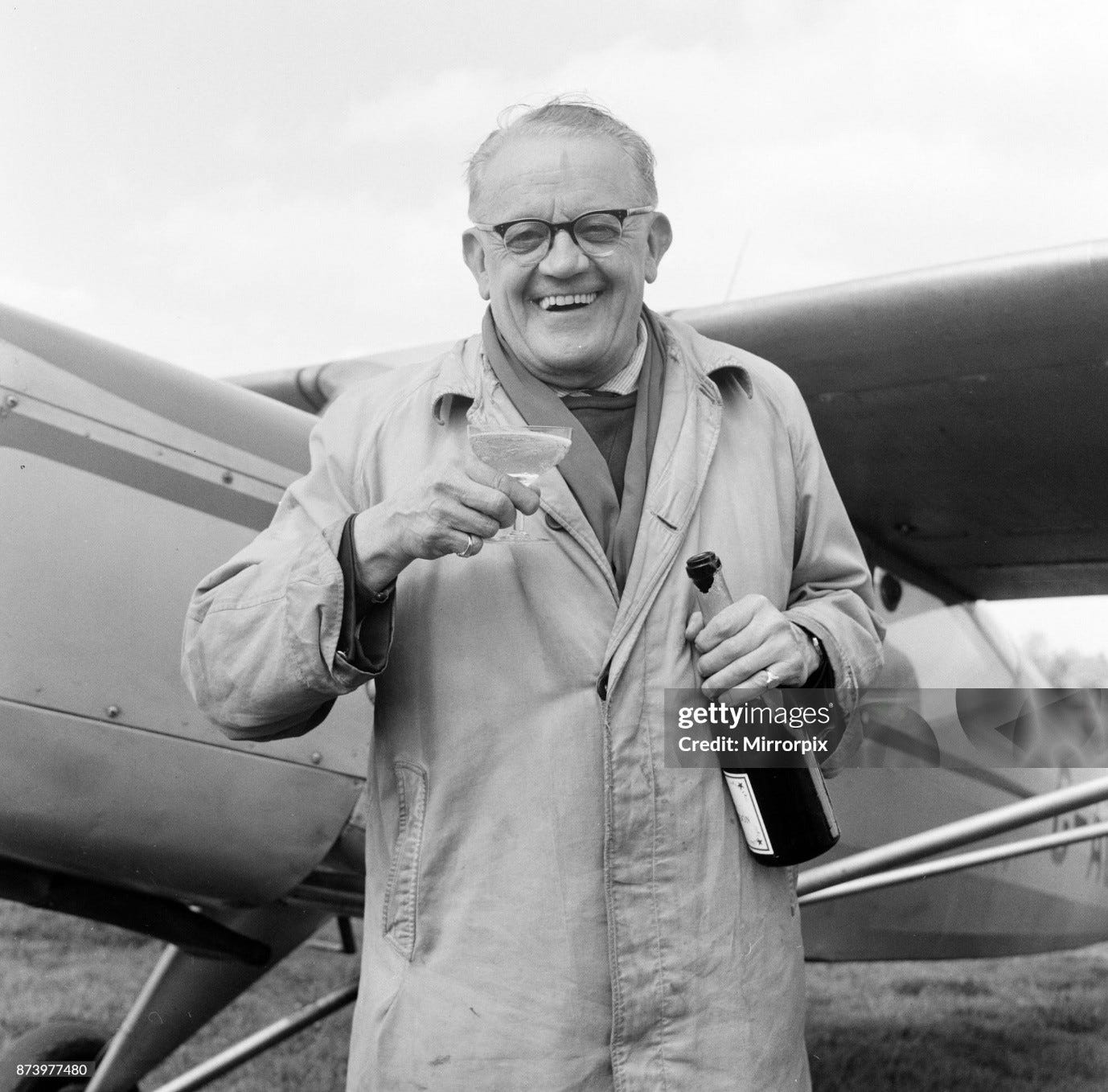
Either way, Squadron Commander Draper, we salute you.
He had a friend with him on the “15 bridges” stunt, with a “cine film camera” ? Or so it seems to suggest in that article 😳