The Pimlico Poisoning!
17 April 1886

It’s 140 years to the day since the not guilty verdict on Adelaide Bartlett, accused of poisoning the husband who was 11 years older than her, possibly in order to take up with a Wesleyan minister who had bought the poison, and who – they claimed – had the dead husband’s blessing to woo Adelaide.
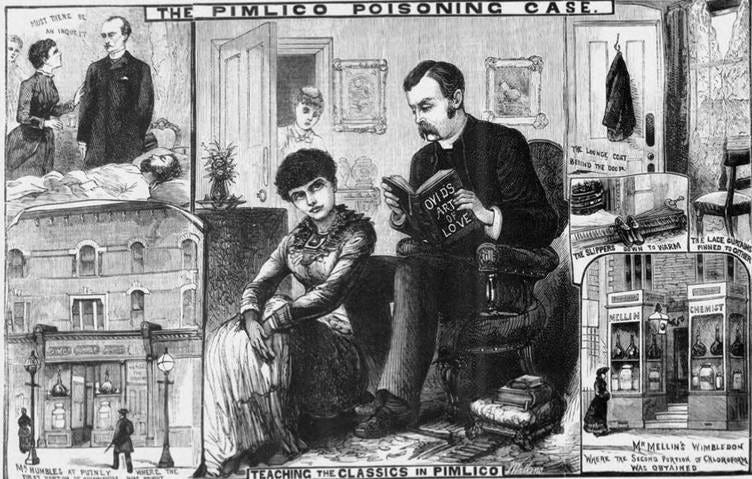
Adélaïde Blanche de la Tremoille was born in Orléans in 1855 (possibly the illegitimate daughter of a count and an English woman), moved to Kingston to live with an aunt, and met Edwin Bartlett, who owned grocery stores and had some cash. Her parents approved, but it was an odd marriage.
As soon as they wed, in 1875, Edwin sent her to a boarding school in Stoke Newington to “rectify gaps in her formal education” according to the British Medical Journal, and then to a finishing school in Belgium. She didn’t live with Edwin (over a shop in Herne Hill) until 1878.
Unfortunately, Edwin’s father, who didn’t like her, lost his wife and moved in, too. He accused Adelaide of having an affair with Edwin’s younger brother Frederick, and Edwin made his father retract the allegations in front of a solicitor.
In 1883, they moved to a flat over another shop in East Dulwich, and in 1885 to Merton Abbey, near Wimbledon, “where they met a 27 year old Wesleyan minister, George Dyson, with whom they became friendly”
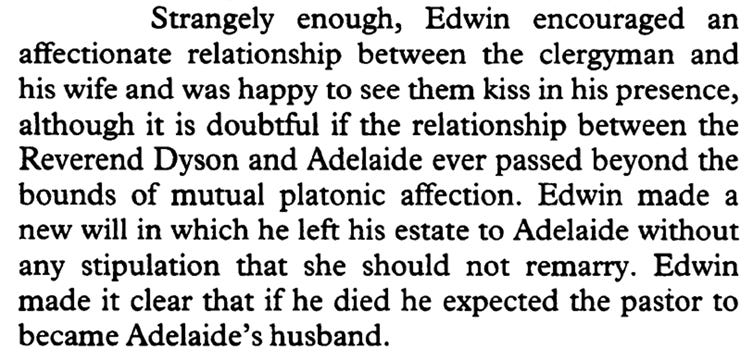
Mind you, according to Adelaide, the Bartletts only had sex once – in order to conceive a child, which was stillborn – although ‘contraceptives’ were found in Edwin’s clothes, and the midwife said that the Bartletts shared a bed, and thought it was “their one act of unprotected intercourse”.
Anyway, in 1885, they were sleeping separately, but in the same room – “the drawing room; she on a couch, he on a folding bed”. This was supposedly because Edwin had terrible breath due to horribly decaying teeth (and the fact that he took mercury because he thought he had syphilis).
All in all, it’s not surprising that Edwin suffered from ‘nerves’ and – according to Colin Wilson in Unsolved Murders and Mysteries – had had a breakdown (which his father said was brought on by “laying a floor”), and that Dyson thought Edwin “exceedingly odd”.
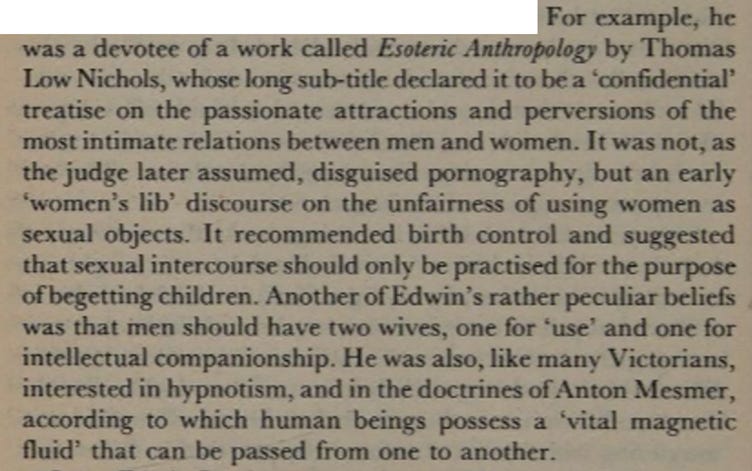
Later in 1885, they moved to Pimlico, and Edwin bought Dyson a season ticket so he could come and visit and ‘tutor’ Adelaide. A maid (according to the BMJ again)
several times came upon Dyson and Adelaide in positions unusual for a tutor and pupil, once surprising them on the floor together.
Edwin’s health still wasn’t good, although a dentist had helped with his teeth, and a doctor diagnosed diarrhoea and gastritis. Adelaide asked for a second opinion because
If Mr Bartlett does not get better soon his friends and relations will accuse me of poisoning him.
(You may wish to imagine your author looking at camera at this point.)
C. J. S. Thompson’s Poisons and Poisoners of 1931 says Edwin’s mercury was “in some way ... being administered to him”, and that Edwin asked for the second opinion because he didn’t want suspicion to fall on his beloved Adelaide. Fuck knows.
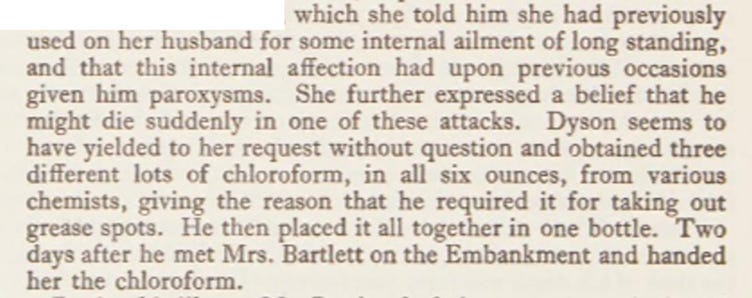
Either way, on 27 December 1885 (or 20th; your guess is as good as mine) Adelaide asked Dyson to buy some chloroform. As the BMJ puts it: “A heavy colourless fluid with a sweet sickly smell, its vapour has been used as an anaesthetic because it is easily administered, is not inflammable, and acts quickly”.
On 31st, “he was apparently in good health”, until 4am when he wasn’t. The first person in the room was the landlord, who “noticed a peculiar smell that reminded him of chloric ether”, and the post mortem said cause of death was “eleven and a quarter grains of pure chloroform” in his stomach.
An inquest led by Athelstan Braxton Hicks (no, really – the coroner son of obstetrician John Braxton Hicks, who gave his name to the contractions, fact fans) said she done him in. Well... ‘wilful murder’ by Adelaide Bartlett, with George Dyson an accessory before the fact, to use their exact terms. Both were arrested.
At the trial, the first thing that happened was the prosecution withdrew their case against Dyson, because they wanted him to be a witness but what he told the court – Adelaide devotedly looked after Edwin, who thought he was terminally ill – only helped the defence.
The prosecution had already said there were only three possibilities: Suicide (“highly improbable”), accident (“practically impossible because the pain that the poison would cause would immediately alert the patient”) and “deliberate administration by another person”. They argued that she’d got him to inhale chloroform from a hanky, and then poured the rest down his throat while he was asleep, but the senior scientific analyst to the Home Office said some would end up in his windpipe that way, and none had been found there.
Another doctor said if she’d poured it down him, he would have vomited, because he’d had a rich meal not long before. The defence couldn’t call Adelaide, because giving sworn evidence on one’s own behalf wasn’t allowed until the Civil Evidence Act of 1898. They also cunningly didn’t call anyone else, preventing the prosecution from hostile questioning of defence witnesses. Instead, barrister Edward Clarke gave a six-hour speech saying Edwin was deeply weird and wanted a platonic relationship with this attractive young woman, and had encouraged her to get it on with Dyson. Then, one day he suddenly decided he fancied a bit of the old how’s-yer-father.
Adelaide felt this was wrong, since she now regarded herself as affianced to Dyson. So she asked Dyson to get her chloroform, so she might wave it in his face if he made sexual demands. However, she had been unable to go through with it. She had never been able to keep a secret from Edwin, and on that last evening of his life, had confessed her intention and showed him the bottle of chloroform.
I think we can all agree that the tragedy of Adelaide and Edwin is that they didn’t live in the era of Viz Comic, when the small ads would have helped them.
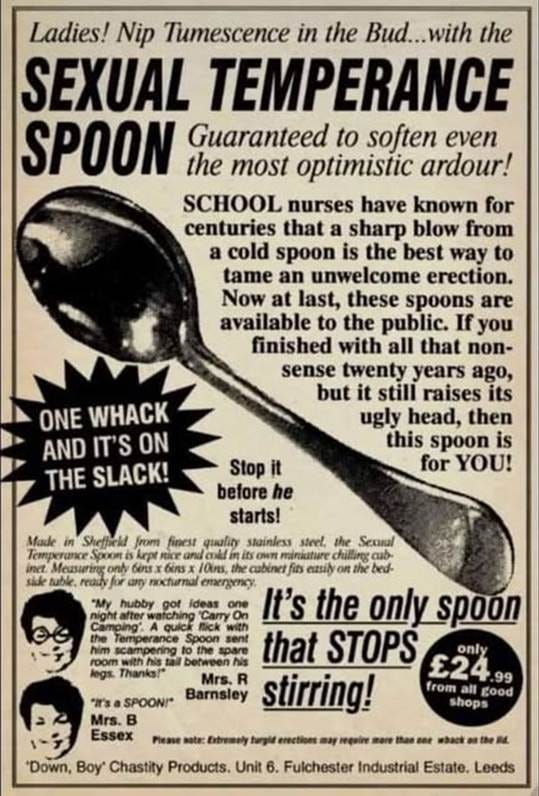
Anyway, while Clarke was less successful when representing Oscar Wilde a few years later, this time, the jury came back and said
Although we think grave suspicion is attached to the prisoner, we do not think there is sufficient evidence to show how or by whom the chloroform was administered.
Surgeon Sir James Paget famously joked “Now that she has been acquitted for murder and cannot be tried again, she should tell us in the interest of science how she did it!” Sadly, she disappeared from the public record, and no one knows whether she and Dyson married or never saw each other again.
One doctor thought that, because had Adelaide confessed she was planning to chloroform him because of his saucy urges, Edwin might have taken the chloroform to make himself ill (and her feel guilty), but accidentally took too much. Another theory is he took it because he thought it was medicine.
The BMJ points out that if his mouth was inflamed after all the dentistry, that “may have delayed the sensations of burning pain until it was too late and he had swallowed the poison” – and she said she poured brandy down his throat to revive him, but it may have been to disguise the smell of chloroform.
Maybe she did it, or maybe he did. Basically, no one has a bleedin’ clue – and in Poirot novel The Clocks in 1963, Agatha Christie was still referring to the Pimlico Poisoning as the kind of ‘old murder’ which the retired Belgian enjoyed reading about and trying to figure out.